

SlideServe
Menu
Préférences
© SlideServe · v2026

BACH

dominy avatar
9 diapositives · 289 Views · Jul 19, 2014

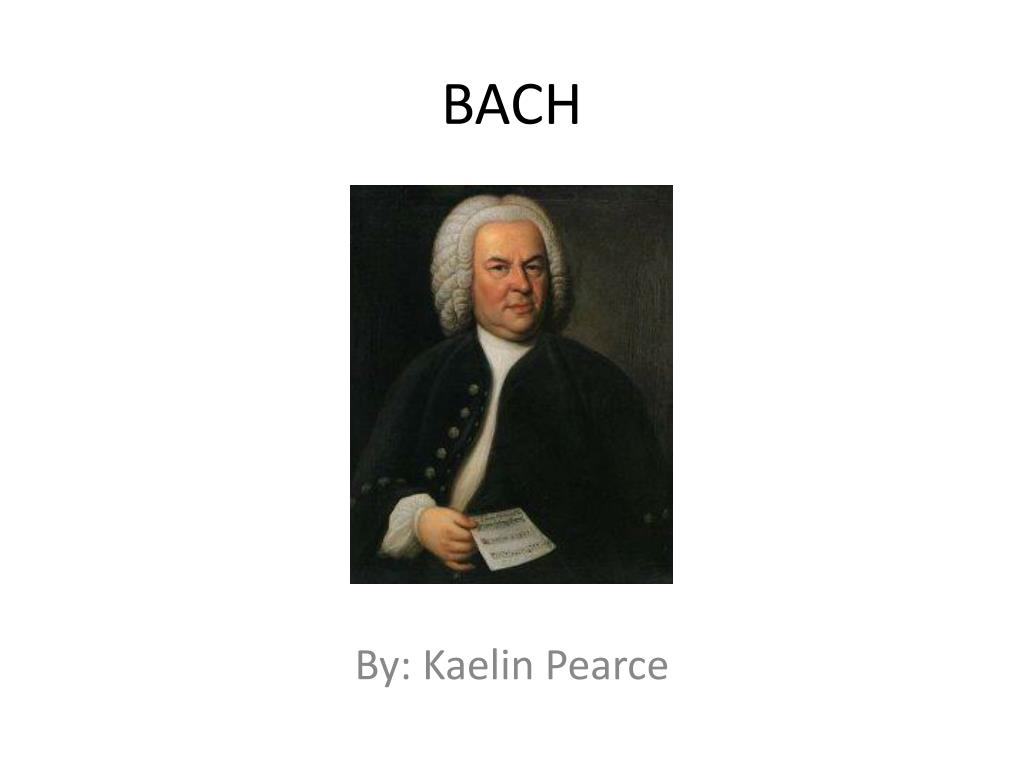
BACH. By: Kaelin Pearce. Who Was Bach.

BACH - slide 1
01 / 9BACH
1 / 17

Télécharger la présentation

BACH
Une image / un lien ci-dessous est fourni (tel quel) pour télécharger la présentation

Politique de téléchargement : le contenu du site vous est fourni TEL QUEL pour votre information et votre usage personnel ; il ne peut être vendu, concédé sous licence ni partagé sur d’autres sites sans l’accord de son auteur.Le contenu vous est fourni TEL QUEL, pour votre information et votre usage personnel uniquement. Téléchargez la présentation en cliquant sur ce lien. Lors du téléchargement, si vous ne parvenez pas à télécharger une présentation, l’éditeur a peut-être supprimé le fichier de son serveur.Pendant le téléchargement, si vous ne parvenez pas à obtenir une présentation, le fichier a peut-être été supprimé par l’éditeur.

F I N

Plus de contenu associé

Transcription de la présentation
  1. BACH By: Kaelin Pearce

  2. Who Was Bach • Johann Sebastian Bach was a German Composer and Organist whose sacred and secular works for choir, orchestra and solo instruments drew together the strands of the Baroque period and brought it to its ultimate maturity. Although he introduced no new forms, he enriched the prevailing German style with robust contrapuntal technique

  3. Bach’s Early Years • Born March 21, 1685 • Bach’s Family had reputation for Musical Talent • Grew up surrounded by musicians • Older brother taught Bach to play Harpsichord and Organ • Became interested in Organ Construction • Studied German Church Music • Sung in Choir as Soprano • Played Violin

  4. Schooling • First attended The Old Latin Grammar School • Then attended The Gymnasium Grammar School • Sung at the Michealis Monastery at Luneburg • Studied the Organ under Dietrich Bextehude

  5. Places he Played • Provided music for the congregation at Arnstadt • Organist at Muhlhausen • Organist for the council of the Duke of Weimer • Then became the leader of the Orchestra • Capellmeister in Cothen • He then spent the rest of his life working as Cantor & Director of Music in Leipzig

  6. History of Works • The Brandenburg Concertos • The Goldberg Variations • The English Suites • The French Suites • The Paritas • The Well-Tempered Clavier • The Mass in B Minor • The St Matthew Passion • The Magnificent • The Music Offering • The Art of Fugue • The Sonatas and Partitas for Violin Solo • The Cello Suites • 200+Cantanas & Similar # of Organ works

  7. His Lifetime and Fame • While Bach's fame as an organist was great during his lifetime, he was not particularly well-known as a composer. His adherence to Baroque forms and contrapuntal style was considered "old-fashioned" by his contemporaries, especially late in his career when the musical fashion tended towards Rococo and later Classical styles. A revival of interest and performances of his music began early in the 19th century, and he is now widely considered to be one of the greatest composers in the Western tradition

  8. Listening Guide-Cello Suite No1 Prelude • 0:00-0:10 the melody rises using a swaying rising and falling rhythm, which then lowers at 0:18 and begins to rise and then fall meanwhile adding new elements of high and low alterations while keeping the same swaying rhythm all along as if telling a story or travelling through a dream. At 1:08 the chord drops low for ten seconds on the eighth note as if something bad is happening then begins to continue but also adding a higher pitch around 1:16 until 1:54 where the tempo begins to quicken adding suspense, the tempo keeping the same initial melody meanwhile rising quickly, then starts to slow at 2:10-2:14 like someone coming into a bright light say from out of the woods. All of a sudden at 2:15 the tempo begins to quicken and rise higher and higher as if something amazing is about to happen and then at 2:21 the sound is so full and alive, it sounds as if a full orchestra is playing behind the cello giving one a feeling of triumph and joy. This continues for ten seconds and the last cord he plays stretches out over the last few seconds of the prelude

  9. Bibliography • http://www.baroquemusic.org/bqxjsbach.html • http://www.bachcentral.com/BachCentral/bio.html • http://www.classicalm.com/en/composer/2/Bach-Johann-Sebastian • http://www.youtube.com/watch?v=zuHQgmoSKGs