PMT Readout and Floor Triggering
190 likes | 391 Vues
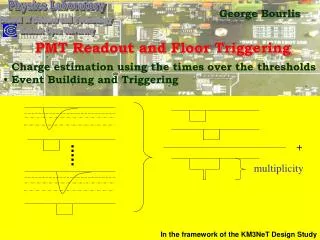
Physics Laboratory. School of Science and Technology. Hellenic Open University. +. multiplicity. George Bourlis. PMT Readout and Floor Triggering. Charge estimation using the times over the thresholds Event Building and Triggering. In the framework of the KM3NeT Design Study.


PMT Readout and Floor Triggering
E N D
Presentation Transcript
Physics Laboratory School of Science and Technology Hellenic Open University + multiplicity George Bourlis PMT Readout and Floor Triggering • Charge estimation using the times over the thresholds • Event Building and Triggering In the framework of the KM3NeT Design Study
ReadOut Electronics 5 PMT Signal Inputs Trigger Output USB Port • HPTDC • 32 channels (LR) – 8 Channels (HR) • 25ps (HR) to 100 ps (LR) accuracy • Self Calibrating 25ps accuracy TDC GPS Input
Input Trigger Time (ns)
@ “nominal” H.V. gain: ~ 4 105 <charge>/p.e. ~ 0.07pCb <pulse height>/p.e. ~ 1.05mV Rise Time: 1.2 ns Single p.e At the Detector Center • Data - Monte Carlo Prediction Charge (pCb) Charge (in units of mean p.e. charge) The Photomultiplier Tube: PH: XP1912 Gain vs HV Calibration
Charge (pC) 1st Threshold only 1st, 2nd & 3rd Threshold 1st & 2nd Threshold Time Over Threshold (s) Charge versus Time Over Threshold 50mV 15mV 4mV
Charge Parameterization 1st & 2nd Threshold 1st, 2nd & 3rd Threshold
11% 8% Charge Estimation 1st & 2nd Threshold 1st, 2nd & 3rd Threshold - Estimated Resolution ~10% - Better if all thresholds are crossed
Charge Estimation 1st & 2nd Threshold 1st, 2nd & 3rd Threshold - σ=(1.01 ± 0.01) (2 thresholds) - σ=(1.1 ± 0.1) (3 thresholds)
HPTDC architecture HPTDC is fed by a 40 MHz clock giving us a basic 25 ns period (coarse count). A PLL (Phase Locked Loop) deviceinside the chip does clock multiplication by a factor 8 (3 bits) to 320 MHz (3.125 ns period) . ADLL (Delay Locked Loop)done by 32 cells fed by the PLL clock acts a 5 bits hit register for each PLL clock (98 ps width LSB = 3.125 ns/32). 4R-C delay linesdivides each DLL bin in 4 parts (R-C interpolation) in high resolution (25ps) mode.