Validity of an Argument on Truth Values in Propositional Logic
Explore the validity of a logical argument by placing truth values under premises and conclusion based on given conditions. Follow the rules to determine if the argument is valid.

Validity of an Argument on Truth Values in Propositional Logic
E N D
Presentation Transcript
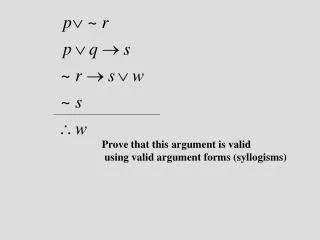
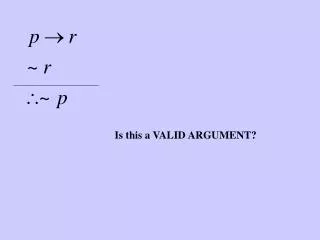
T T false If there is a row T T F it must be one of the first two rows The conclusion is false only if p is true
T T T T false Now place truth values under the second premise.
F F true If there is a row T T F then it must be the second row When the conclusion is false the second premise is true only if r is false T T T T false
false F In this case, we won’t find it because under these conditions the first premise is false T F F true T F T false We have eliminated all but one row in our search for the possibility T T F
T F false F true T F F T false VALID There are NO conditions under which the conclusion is false when the premises are true. If the premises are true then you must accept the conclusion.
F T T F F T false F T The conclusion is false only when r is trueand q is false
F T T F F T false F T Assign values to premise #1
F T T F F T false F T Assign values to premise #1
T F true T T T T F F T false F T When the conclusion is false, the first premise is true only when p is true
T F true T T false T T F F T F false VALID F T There are no conditions under which the conclusion is false and the premises are true.
F F F F false F F The conclusion is false only if r is false
F F F F false F F Place truth values under premise #1
F F F F false F F When the conclusion is false premise #1 is true only when p is false
F F true F F F F false F F F F When the conclusion is false premise #1 is true only when p is false
F F true F F F F false F F F F If there is a row T T F then it is one of the yellow rows - complete them
F F true F T F true F F false F F T F F If there is a row T T F then it is one of the yellow rows - complete them
F F true F T F true F F false F F T invalid F F There are conditions under which the premises are true but the conclusion is false.
F F The conclusion is FALSE only if r is F F false
T Under these conditions, this premise is TRUE only if p is T T F true F F false
T T Under these conditions, this premise is TRUE only if qT true T T F true F F false
T T true F T T F true Under these conditions, this premise is TRUE only if s is F F F true F false
F T T true F T Under these conditions, this premise is FALSE T F true F F true F false
F T T It is not possible for all of the premises to be true when the conclusion is false. This is a valid argument. true F T false T F true F F true F false