
Managing Intangible Assets and Creativity: Insights from Cranfield Masterclass
Explore the intricacies of managing intangible assets and the creativity that drives organizational success in this insightful masterclass hosted by Cranfield School of Management. Delve into knowledge management, intellectual capital, and metrics that measure contextual and contingent factors. Understand the significance of dynamic capabilities in navigating the uncertainties of socio-economic practice while balancing rational decision-making with imaginative exploration. This session emphasizes leadership, collaborative practices, and the transformative role of creativity in the modern business landscape.

Managing Intangible Assets and Creativity: Insights from Cranfield Masterclass
E N D
Presentation Transcript
developing intangible assets – managing others’ creativity JC Spender Cranfield SOM Cranfield Masterclass
find, measure, control, re-allocate • knowledge management = dream of controlling the intangible resources and so achieving total control • KIFs, learning organizations, Tobin’s Q - mkt/book - collapse of accounting ? • hedge funds, private capital, eco-economics and sustainability • intellectual capital ? human, structural, and social • metrics ? contextual and contingent SO … • failure of rational decision-making • dependence on the creativity of our people • managerial role ? Cranfield Masterclass
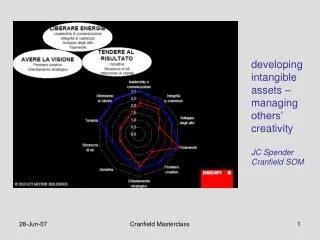
metrics ? • what to model against - targets, competitors, optimizing model, or ? • contextual possibilities ? i.e. customers, stakeholders, strategic positioning, CSR • ‘success map’ dimensions – Balanced Scorecard, Miles & Snow, OSCI, business risk, any single model ? • virtual company vs real company • place and effect of the measurement tool • managing, creating by measuring • how useful is this whole idea ? dynamic capabilities ? Cranfield Masterclass
complementing rationality certainty-based analysis uncertainty-based practices imagination agency empowerment delegation causal models rationality purposive action real situations - world of socio-economic practice Cranfield Masterclass
organizational practice • Practice 1: purposive - rational, planned, mechanical but only when the situation is fully known - otherwise: • Practice 2: ‘work-arounds’, absence of knowledge • imaginative, exploratory • discovered constraints to the imagination, agency Cranfield Masterclass
constraints customer response budget technological limits of plant market position metrics as constraints - but to whose imagination ? Cranfield Masterclass
collaborative agentic practice • workaround - getting it done and there’s more to it: • transformation of the agent/s • re-construction of firm’s context i.e. what is known • segue to leadership, sense of belonging, community, CoPs, networks of trust, recognition Cranfield Masterclass
leadership business model business goal causal models rationality direction control agency empowerment emancipation trust real situations - world of practice seeing pre-existing conditions as externally determined tangible and intangible resources guiding & re-constructing the firm’s constraints dynamic capabilities > Δ resources Cranfield Masterclass
theorizing business as a managed collaborative art form • and the business model as its performance • contingent viability as the only metric engagement - imagination - exploration - constraints details, details, details - work, work, work Cranfield Masterclass
