
Breakthrough in Solid-State Superfluorescence Using Advanced Technology and Facilities
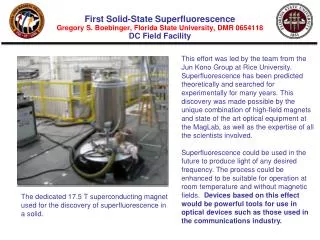
This groundbreaking research led by the Jun Kono Group at Rice University unveiled the first solid-state superfluorescence. Enabled by cutting-edge high-field magnets and optical equipment at the MagLab, this discovery opens new avenues in light production at any desired frequency. The potential to enhance this process for room-temperature operation without magnetic fields promises powerful applications in optical devices, particularly within the communications industry. The dedicated 17.5 T superconducting magnet played a crucial role in this significant advancement.

Breakthrough in Solid-State Superfluorescence Using Advanced Technology and Facilities
E N D
Presentation Transcript
First Solid-State SuperfluorescenceGregory S. Boebinger, Florida State University, DMR 0654118DC Field Facility This effort was led by the team from the Jun Kono Group at Rice University. Superfluorescence has been predicted theoretically and searched for experimentally for many years. This discovery was made possible by the unique combination of high-field magnets and state of the art optical equipment at the MagLab, as well as the expertise of all the scientists involved. Superfluorescence could be used in the future to produce light of any desired frequency. The process could be enhanced to be suitable for operation at room temperature and without magnetic fields. Devices based on this effect would be powerful tools for use in optical devices such as those used in the communications industry. The dedicated 17.5 T superconducting magnet used for the discovery of superfluorescence in a solid.