Water Properties
Water is a unique substance with remarkable physical and chemical properties. It exists in three states: liquid, gas, and solid, with a freezing point of 32°F and boiling point of 212°F. With a neutral pH of 7, pure water does not conduct electricity and has a high specific heat capacity, absorbing significant heat before evaporating. Water’s cohesive nature and high surface tension enable it to dissolve more substances than any other liquid, making it an essential universal solvent. However, its ability to attract and distribute pollutants poses environmental challenges.

Water Properties
E N D
Presentation Transcript
Physical • Liquid, Gas, and Solid • Freezes at 32° Fahrenheit (F) and boils at 212°F • pH of 7 • Cohesive • The stickiest of the non-metallic liquids • Pure water doesn’t conduct electricity • High specific heat index • Absorbs a lot of heat before it evaporates • High surface tension • High density
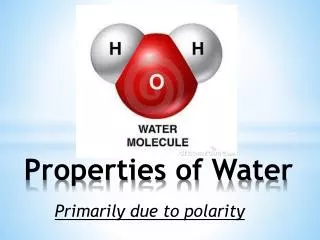
Chemical • Universal solvent • Dissolves more substances than other liquids • Important: • takes with it valuable chemicals, minerals, and nutrients (especially in our bodies) • Why: • “Water molecules have a polar arrangement of oxygen and hydrogen atoms—one side (hydrogen) has a positive electrical charge and the other side (oxygen) had a negative charge.” • Attracted to many different types of molecules • BAD: • Pollution is easily attracted and distributed by it.