Download
1 / 8
80 likes | 187 Vues
Reanalysis of GISP2 ice core data reveals evidence for a nitrate spike around early 1860, challenging previous late 1859 dating. Utilizing ECM markers and annual nitrate cycles, the study suggests a refined dating methodology.

E N D
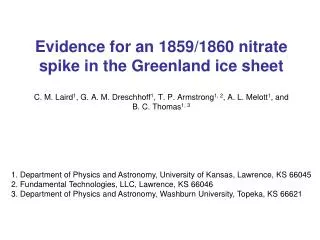
Evidence for an 1859/1860 nitrate spike in the Greenland ice sheetC. M. Laird1, G. A. M. Dreschhoff1, T. P. Armstrong1, 2, A. L. Melott1, andB. C. Thomas1, 3 1. Department of Physics and Astronomy, University of Kansas, Lawrence, KS 660452. Fundamental Technologies, LLC, Lawrence, KS 66046 3. Department of Physics and Astronomy, Washburn University, Topeka, KS 66621
A reanalysis of the GISP2 H ice core ECM (Electrical Conductivity Method) and nitrate data around the NO3- spike previously dated to late 1859 suggests the feature most likely appears in early 1860.
Dating Methodology – GISP2 H Core Dreschhoff and Zeller, 1994 Utilized standard method for absolute dating of ice cores: • ECM (volcanism) – establishes marker years 1853, 1854, 1883,… • proxies exhibiting annual cycles (e.g. nitrates) - count/interpolate years between markers • combining 1. and 2. gives annual dating => Nitrate spike most probably occurs in 1860. one or two years 1859 or 1860
GISP2 H Core Segment - Dreschhoff and Zeller, 1994 (evenly-spaced samples) ECM NO3- • Shiveluch (1854) and Krakatau (1883) ECM markers bracket nitrate spike • annual nitrate cycles count/interpolate years between markers • 1. & 2. => NO3- spike most probably occurs in 1860 (not 1862/1863)