Advanced Techniques in UV-Vis and Infrared Absorption Spectroscopy
This comprehensive overview explores the principles and applications of both UV-Vis and infrared absorption spectroscopy. It highlights key components, including radiation sources, detectors, and dispersion methods such as dispersive and FT-NIR spectrometers. Learn about the techniques that measure the transmission of light as a function of frequency and how interferometric methods capture all frequencies simultaneously, offering multiplex advantages. Additional discussions include addressing Rayleigh scattering in Raman spectroscopy and optimizing detection using various optical components for accurate spectral analysis.

Advanced Techniques in UV-Vis and Infrared Absorption Spectroscopy
E N D
Presentation Transcript
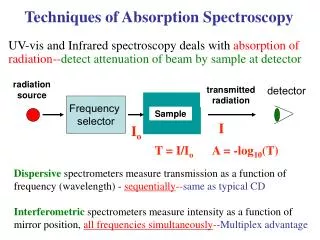
Techniques of Absorption Spectroscopy UV-vis and Infrared spectroscopy deals with absorption of radiation--detect attenuation of beam by sample at detector radiation source transmitted radiation detector Frequency selector Sample I Io T = I/Io A = -log10(T) Dispersive spectrometers measure transmission as a function of frequency (wavelength) - sequentially--same as typical CD Interferometricspectrometers measure intensity as a function of mirror position, all frequencies simultaneously--Multiplex advantage
Dispersive and FT-NIR Spectrometer Wolfram-Lampe(Tungsten lamp); Gitter(Grating); Spalt(Slit); Lichtquelle(Light source); Spiegel(Mirror), Detektor(Detector); Probe(Sample), Spektrum(Spectrum)
Sample Detector: PMT or CCD for multiplex Lens Filter Single, double or triple monochromator Laser Dispersive Fluorescence or Raman • -use filter or double monochromator to eliminate the intense Rayleigh scattered & reflected light • --Fluorescence not big problem • Raman typically 108 weaker than excitation • Disperse the light onto a detector to generate a spectrum Polarizer Detect intensity, I, against zero background--ideal