Download
1 / 22
220 likes | 327 Vues
This overview explores chemical reaction rates and energy changes during reactions. It distinguishes between endothermic reactions, which absorb heat, and exothermic reactions, which release heat. The role of reaction kinetics is highlighted, emphasizing the necessity of molecular collisions for reactions to occur and the importance of activation energy. Key factors affecting reaction rates include temperature, concentration, catalysts, and surface area. Additionally, the concept of chemical equilibrium and Le Chatelier's Principle is introduced, detailing how systems respond to changes.

E N D
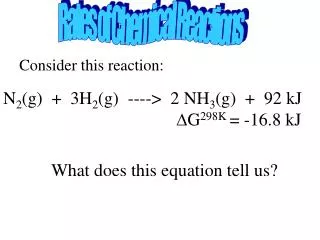
Heat of Reaction The amount of heat released or absorbed during a chemical reaction. Endothermic: Reactions in which energy is absorbed as the reaction proceeds. Exothermic: Reactions in which energy is released as the reaction proceeds.
Chemical Kinetics The area of chemistry that concerns reaction rates. Key Idea: Molecules must collide to react. However, only a small fraction of collisions produces a reaction. Why?
Collision Model Collisions must have enough energy to produce the reaction (must equal or exceed the activation energy). Orientation of reactants must allow formation of new bonds.
Reaction Rate • Speed at which a chemical reaction takes place • Reaction rate depends on the collisions between reacting particles. • Determined by measuring the change in concentration of a reactant or product per unit of time
Factors Affecting Reaction Rates • Temperature: Measure of average kinetic energy of the molecules in a substance • Concentration: amount of molecules present in a unit volume • Catalyst: an agent that speeds up the rate of chemical rxns w/out being permanently changed or used up • Surface area: area of the surface
Temperature • Molecules at higher temp. have higher KE and move fastermore collisionsfaster rxn rate • A 10°C increase in Tempdouble the rate of rxn • Temp Collisions Rxn rate
Concentration • Increasing concentration increases chance of effective collisions faster rxn rate • Conc Rxn Rate
Catalysts • Provides a shorter pathway for the reactants to follow as they change into products (like a tunnel cut through a mountain) • Lowers Activation Energy • Speeds up rxn rate without being consumed in the rxn • + Catalysts Activation E Rxn Rate ENZYMES
Ea Activation Energy (Ea) • depends on reactants • minimum energy required for a reaction to occur • low Ea = fast rxn rate
Surface Area • high SA = fast rxn rate • more opportunities for collisions • Increase surface area by… • using smaller particles • dissolving in water • SA Collisions Rxn Rate
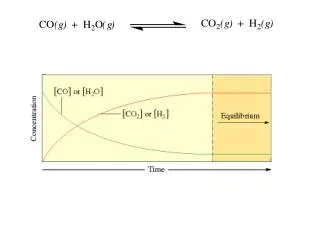
Chemical Equilibrium Reversible Reactions: A chemical reaction in which the products can react to re-form the reactants Chemical Equilibrium: When the rate of the forward reaction equals the rate of the reverse reaction and the concentration of products and reactants remains unchanged 2HgO(s) 2Hg(l) + O2(g) Arrows going both directions ( ) indicates equilibrium in a chemical equation
LeChatelier’s Principle When a system at equilibrium is placed under stress, the system will undergo a change in such a way as to relieve that stress.
Le Chatelier Translated: When you take something away from a system at equilibrium, the system shifts in such a way as to replacewhat you’ve taken away. When you add something to a system at equilibrium, the system shifts in such a way as to use up what you’ve added.
Equilibrium Shift • Consider the following reaction N2 + 3H2 2NH3 What is the effect of increasing the amount of ammonia? (which way would the equilibrium shift?)
Equilibrium shift • Consider the following reaction H2O2 H2O + O2 What is the effect of decreasing the amount of H2O2 ? (which way would the equilibrium shift?)
An increase in temp. speeds the rxn rate because the • A) distance between molecules increases • B) distance between molecules decreases • C) # of collisions increases • D) # of collisions decreases As the # of collisions between reactants increases, the • A) Reaction stops • B) rate of rxn decreases • C) rate of rxn increases • D) rate of rxn remains the same