Mineral Vocabulary
130 likes | 258 Vues
This guide outlines foundational terms in mineralogy, including definitions and characteristics of elements, compounds, molecules, and various types of chemical bonds (covalent, ionic, metallic). It describes minerals and their properties, such as crystal structure and specific gravity. Additionally, it covers the classification of native elements and silicates, and introduces Moh's hardness scale for assessing scratch resistance. This concise overview equips readers with essential mineral vocabulary to aid in further studies or practical applications.


Mineral Vocabulary
E N D
Presentation Transcript
Mineral Vocabulary INB pp. 2 & 3 p. 3: definitions p. 2: illustrations and/or examples
ELEMENT • The simplest form of a substance that cannot be broken down into smaller parts
COMPOUND • Substance that contains two or more elements chemically combined (different than a molecule) Each color represents DIFFERENT elements!
MOLECULE • Group of atoms that are linked together by chemical bonds (can be from the SAME element)
COVALENT BOND • Strongest of the chemical bonds; two atoms SHARE electrons
IONIC BOND • Bond made from two oppositely charged ions (positive & negative) attracting and bonding together
METALLIC BOND • Weakest of the chemical bonds; minerals with streak have this type of bond
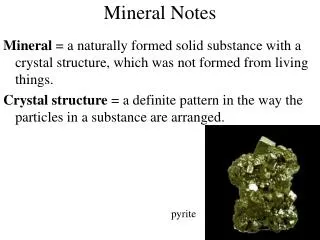
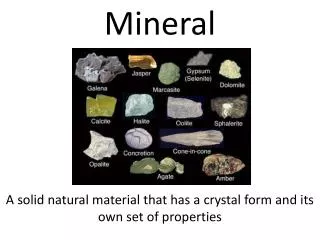
mineral • Solid, inorganic substance that occurs in nature, with a definite chemical composition and a crystal structure (ISODA)
CRYSTAL • When atoms are bonded together in a repeating pattern
NATIVE ELEMENT • Also called a native mineral; an element that meets the 5 criteria for a mineral and is also found on the periodic table • EX: gold, silver, copper, sulfur, diamond, and graphite
SILICATE • mineral group that forms the common rock forming minerals; all have a silicon and oxygen atom
SPECIFIC GRAVITY • The density of a mineral compared to the density of water
Moh’s hardness • Scale that compares a mineral’s resistance to being scratched on a scale from 1 to 10; 10 being the hardest