Download
1 / 1
10 likes | 130 Vues
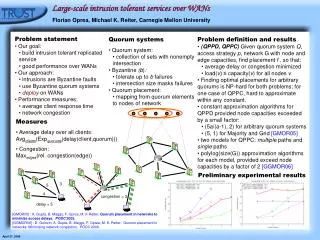
This paper addresses the critical problem of designing intrusion-tolerant replicated services over wide area networks (WANs). The objective is to ensure good performance while tolerating Byzantine faults. We utilize Byzantine quorum systems to deploy services over WANs, focusing on minimizing average client response time and network congestion. Key innovations involve optimal quorum element placements to achieve this goal, considering node capacities and various performance measures. Our results indicate effective strategies for minimizing delays and congestion within the given constraints.

E N D
Large-scale intrusion tolerant services over WANs Florian Oprea, Michael K. Reiter, Carnegie Mellon University • Problem statement • Our goal: • build intrusion tolerant replicated service • good performance over WANs • Our approach: • intrusions are Byzantine faults • use Byzantine quorum systems • deploy on WANs • Performance measures: • average client response time • network congestion • Quorum systems • Quorum system: • collection of sets with nonempty intersection • Byzantine (b): • tolerate up to b failures • intersection size masks failures • Quorum placement: • mapping from quorum elements to nodes of network • Problem definition and results • (QPPD, QPPC) Given quorum system Q, access strategy p, network G with node and edge capacities, find placement f , so that: • average delay or congestion minimized • load(v) ≤ capacity(v) for all nodes v • Finding optimal placements for arbitrary quorums is NP-hard for both problems; for one case of QPPC, hard to approximate within any constant. • constant approximation algorithms for QPPD provided node capacities exceeded by a small factor: • (5a/(a-1), 2) for arbitrary quorum systems • (5, 1) for Majority and Grid [GMOR05] • two models for QPPC: multiple paths and single paths • polylog(size(G)) approximation algorithms for each model, provided exceed node capacities by a factor of 2 [GGMOR06] • Measures • Average delay over all clients: Avgclients(Expquorums(delay(client,quorum))) • Congestion: • Maxedges(rel. congestion(edge)) Preliminary experimental results 3 5 4 congestion = 3 delay = 5 [GMOR05] : A. Gupta, B. Maggs, F. Oprea, M. K Reiter. Quorum placement in networks to minimize access delays. PODC 2005. [GGMOR06] : D. Golovin, A. Gupta, B. Maggs, F. Oprea, M. K. Reiter. Quorum placement in networks: Minimizing network congestion. PODC 2006. April 27, 2006