Overview of Presynaptic and Postsynaptic Neurotransmitter Mechanisms
This detailed exploration of presynaptic and postsynaptic neurotransmitter dynamics covers essential concepts such as the types of neurotransmitters, their synthesis, and mechanisms of action. It delves into small molecules like acetylcholine, dopamine, norepinephrine, and serotonin, as well as their roles as second messengers in neural signaling. The discussion highlights the principles of signal lengthening, amplification, divergence, convergence, spatial spreading, and the regulation of gene transcription. Essential figures and tables illustrate these complex interactions within the nervous system.

Overview of Presynaptic and Postsynaptic Neurotransmitter Mechanisms
E N D
Presentation Transcript
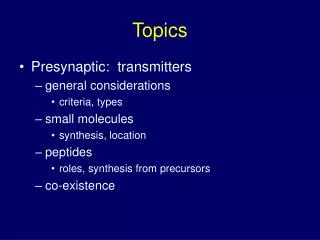
Topics • Presynaptic: transmitters • general considerations • criteria, types • small molecules • synthesis, location • peptides • roles, synthesis from precursors • co-existence
Topics • Postsynaptic: second messengers • access • 7 transmembrane domain receptors, G proteins • types • cAMP, AA, DAG, IP3 • protein kinases • truncating pathway • utility
O CH3-C-O-CH2-CH2-N+-(CH3)3 + CoA HO- HO- HO- HO- -CH-CH2-NH2 -CH2-CH2-NH2 OH N H CAT acetyl CoA + choline acetylcholine AAAD TH tyrosine + O2 L-DOPA dopamine DBH dopamine norepinephrine OH HO- PNMT norepinephrine HO- -CH-CH2-NH-CH3 epinephrine TrH AAAD -CH2-CH2-NH2 tryptophan + O2 5-HTP serotonin GAD gamma-amino butyric acid (GABA) glutamate
Utility of second messengers • lengthening of signal • amplification of signal • divergence to several targets • convergence to single target • spatial spreading of signal • regulation of gene transcription