Enhancing Land Governance and Poverty Reduction through IT and FLOSS Solutions
This document outlines key conclusions and discussions from workshops held by the FAO, FIG, and the World Bank regarding land governance, registration, and their role in poverty reduction. The emphasis is on the importance of access to land and security of tenure in achieving food security, social stability, and economic growth. Challenges in implementing IT and Land Registration systems, particularly in developing countries, are highlighted, along with the potential of Free, Libre, and Open Source Software (FLOSS) to support local development and improve land administration efficiency.

Enhancing Land Governance and Poverty Reduction through IT and FLOSS Solutions
E N D
Presentation Transcript
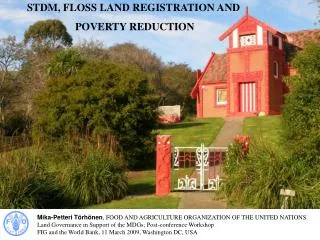
STDM, FLOSS LAND REGISTRATION AND POVERTY REDUCTION Workshop Conclusions Discussion – 30 August 2007 Mika-Petteri Törhönen, FOOD AND AGRICULTURE ORGANIZATION OF THE UNITED NATIONS Land Governance in Support of the MDGs; Post-conference Workshop FIG and the World Bank, 11 March 2009, Washington DC, USA
FAO Philosophy on Land • Access to land and the security of tenure form the foundation for: • Food security • Social stability • Economic growth • Poverty Reduction
Cadastre and Land Registration • Provide security of tenure • Provide accurate information on rights to land • Monitor and facilitate access to land
IT; Great Promise in LR • Logical structures of IT systems help to sort out messy and ad hoc land processes and records. • IT pushes systems to a greater level of standardisation improving equality and quality. • WEB-based solutions increase transparency with direct implications to governance.
Issues in IT & LR IT systems in Land Registration improve the security of tenure. IF THEY ARE SUSTAINABLE!
Experiences with IT and LR • IT brought a hope of standard service for rich and poor, but became a bottleneck of feasible land administration. • Developing countries LRs have struggled in the establishment and maintenance of IT. • Transitional countries have been more successful, but also struggled.
Key Problems • Administrations lack of: • IT knowledge and experience • Capacities to manage often complicated IT projects. • Capacities are continuously lost to the private sector. • Outsourcing has helped, but also failed.
Approaches • ‘Big Bang’ IT projects have failed more often than succeeded (WB contracts). • Incremental and local ICT projects have been more successful and less vulnerable than big projects.
Free, Libre and Open Source Software • FLOSS is a combination of two movements: • Free Software Foundation => • Software that can be used, copied, studied, modified and redistributed without restriction • Open Source Initiative • Software in which the source code is available for modification and redistribution by the general public
FLOSS Potential • Sharing code and solutions may lower the entry point for the IT introduction to LR. • FLOSS LR Community could provide support to lone IT developers in the Developing World. • FLOSS LR Community would allow learning from others. • FLOSS suits well for local tailored development.
FAO FLOSS; OSCAR • With FIG 7, the WB TG and theUniversity of Otago. • Studies; workshops http://source.otago.ac.nz/oscar/OSCAR_Home http://www.fig.net/commission7/wgroups/wg7_3_07_10.htm • Open Source Cadastre and Land Registration software shell design using STDM based data model.
FAO FLOSS; OSCAR • Stand up phase • Next step either real cases implementation project through an open source development project or just • Wrap publication with partners.
STDM • Result of a huge effort. Auguri! • Helped the OSCAR work to start. • Can help others!
STDM • ISO process: • Very useful as a technical guideline. • Should not become a standard. • Social domain discussion good, helpful in promoting our cause, but technically difficult to understand.
FOOD AND AGRICULTURE ORGANIZATION OF THE UNITED NATIONS helping to build a world without hunger Thank You!