
Understanding Combined Path Loss and Shadowing in Cellular Networks
This lecture outlines key concepts in cellular communication, focusing on combined path loss and shadowing. Important announcements include homework deadlines and office hours. Key topics include models for path loss due to distance, empirical measurement approaches, and the effects of shadowing on cell coverage. The lecture emphasizes the significance of log-normal distributions in modeling random attenuation and illustrates how these phenomena impact outage probability and coverage area in cellular networks. Practical examples and empirical parameters are discussed for a comprehensive understanding.

Understanding Combined Path Loss and Shadowing in Cellular Networks
E N D
Presentation Transcript
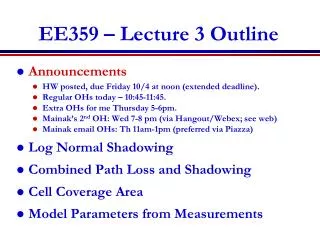
EE359 – Lecture 3 Outline • Announcements • HW posted, due Friday 10/4 at noon (extended deadline). • Regular OHs today – 10:45-11:45. • Extra OHs for me Thursday 5-6pm. • Mainak’s 2nd OH: Wed 7-8 pm (via Hangout/Webex; see web) • Mainak email OHs: Th 11am-1pm (preferred via Piazza) • Log Normal Shadowing • Combined Path Loss and Shadowing • Cell Coverage Area • Model Parameters from Measurements
Lecture 2 Review • Ray Tracing Models • Free Space Model • Power falloff with distance proportional to d-2 • Two Ray Model • Power falloff with distance proportional to d-4 • Empirical Models • Simplified Model: Pr=PtK[d0/d]g, 2g8. • Captures main characteristics of path loss • Two slope model • Power fall off K[d0/d]g1below dc, K[d0/d]g2above dc
Shadowing • Models attenuation from obstructions • Random due to random # and type of obstructions • Typically follows a log-normal distribution • dB value of power is normally distributed • m=0 (mean captured in path loss), 4<s<12 (empirical) • CLT used to explain this model • Decorrelated over decorrelation distance Xc Xc
Slow Combined Path Loss and Shadowing • Linear Model: y lognormal • dB Model 10logK Pr/Pt (dB) Very slow -10g log d
Outage Probabilityand Cell Coverage Area • Path loss: circular cells • Path loss+shadowing: amoeba cells • Tradeoff between coverage and interference • Outage probability • Probability received power below given minimum • Cell coverage area • % of cell locations at desired power • Increases as shadowing variance decreases • Large % indicates interference to other cells
K (dB) 2 sy 10g log(d0) Model Parameters fromEmpirical Measurements • Fit model to data • Path loss (K,g), d0 known: • “Best fit” line through dB data • K obtained from measurements at d0. • Exponent is MMSE estimate based on data • Captures mean due to shadowing • Shadowing variance • Variance of data relative to path loss model (straight line) with MMSE estimate for g Pr(dB) log(d)
Main Points • Random attenuation due to shadowing modeled as log-normal (empirical parameters) • Shadowing decorrelates over decorrelation distance • Combined path loss and shadowing leads to outage and amoeba-like cell shapes • Cellular coverage area dictates the percentage of locations within a cell that are not in outage • Path loss and shadowing parameters are obtained from empirical measurements
