Understanding Compiler Design: Terminology, Grammar, and Analysis Techniques
This article covers essential concepts in compiler design, including terminology related to declarations, assignments, grammar, syntax, and semantics. We explore the compilation process, highlighting components like lexical analysis, syntactic analysis, and code generation. You'll learn the roles of scanner, parser, and the importance of grammar rules defined in Backus-Naur Form (BNF). The techniques of operator-precedence parsing and recursive-descent parsing are also discussed, providing a comprehensive overview of how programming languages are processed by compilers.

Understanding Compiler Design: Terminology, Grammar, and Analysis Techniques
E N D
Presentation Transcript
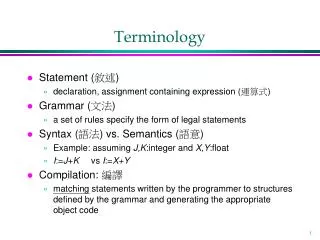
Terminology • Statement (敘述) • declaration, assignment containing expression (運算式) • Grammar (文法) • a set of rules specify the form of legal statements • Syntax (語法) vs. Semantics (語意) • Example: assuming J,K:integer and X,Y:float • I:=J+K vs I:=X+Y • Compilation: 編譯 • matching statements written by the programmer to structures defined by the grammar and generating the appropriate object code
System Software • Assembler • Loader and Linker • Macro Processor • Compiler • Operating System • Other System Software • RDBS • Text Editors • Interactive Debugging System
Basic Compiler • Lexical analysis -- scanner • scanning the source statement, recognizing and classifying the various tokens • Syntactic analysis -- parser • recognizing the statement as some language construct • Code generation --
PROGRAM STATS VAR SUM , SUMSQ , I Scanner SUM := 0 ; SUMSQ := READ ( VALUE ) ;
Parser • Grammar: a set of rules • Backus-Naur Form (BNF) • Ex: Figure 5.2 • Terminology • Define symbol ::= • Nonterminal symbols <> • Alternative symbols | • Terminal symbols
<read> ::= READ (<id-list>) <id-list>::= id | <id-list>,id <assign>::= id := <exp> <exp> ::= <term> | <exp>+<term> | <exp>-<term> <term>::=<factor> | <term>*<factor> | <term> DIV <factor> <factor>::= id | int | <exp> READ(VALUE) SUM := 0 SUM := SUM + VALUE MEAN := SUM DIV 100 Parser
Lexical Analysis • Function • scanning the program to be compiled and recognizing thetokens that make up the source statements • Tokens • Tokens can be keywords, operators, identifiers, integers, floating-point numbers, character strings, etc. • Each token is usually represented by some fixed-length code, such as an integer, rather than as a variable-length character string (see Figure 5.5) • Token type, Token specifier (value) (see Figure 5.6)
Scanner Output • Token specifier • identifier name, integer value • Token coding scheme • Figure 5.5
Token Recognizer • By grammar • <ident> ::= <letter> | <ident> <letter>| <ident><digit> • <letter> ::= A | B | C | D | … | Z • <digit> ::= 0 | 1 | 2 | 3 | … | 9 • By scanner - modeling as finite automata • Figure 5.8(a)
Recognizing Identifier • Identifiers allowing underscore (_) • Figure 5.8(b)
Recognizing Integer • Allowing leading zeroes • Figure 5.8(c) • Disallowing leading zeroes • Figure 5.8(d)
Scanner -- Implementation • Figure 5.10 (a) • Algorithmic code for identifer recognition • Tabular representation of finite automaton for Figure 5.9
Syntactic Analysis • Recognize source statements as language constructs or build the parse tree for the statements • bottom-up: operator-precedence parsing • top-down:: recursive-descent parsing
Operator-Precedence Parsing • Operator • any terminal symbol (or any token) • Precedence • * » + • + « * • Operator-precedence • precedence relations between operators
Operator-Precedence Parse Example BEGIN READ ( VALUE ) ;
(i) … id1 := id2 DIV (ii) … id1 := <N1> DIV int - (iii) … id1 := <N1> DIV <N2> - (iv) … id1 := <N3> - id3 * (v) … id1 := <N3> - <N4> * id4 ;
(vi) … id1 := <N3> - <N4> * <N5> ; (vi) … id1 := <N3> - <N6> ; (vii) … id1 := <N7> ;
Operator-Precedence Parsing • Bottom-up parsing • Generating precedence matrix • Aho et al. (1988)
Shift-reduce Parsing with Stack • Figure 5.14
Recursive-Descent Parsing • Each nonterminal symbol in the grammar is associated with a procedure • <read> ::= READ (<id-list>) • <stmt> ::= <assign> | <read> | <write> | <for> • Left recursion • <dec-list> ::= <dec> | <dec-list>;<dec> • Modification • <dec-list> ::= <dec> {;<dec>}