Polarized Electron Generation and Measurement at KEK: Advances in Laser-based Polarity Techniques
400 likes | 536 Vues
This presentation by Tsunehiko Omori and collaborators details the techniques and experimental results for generating polarized electrons and gamma rays at KEK, utilizing laser-based methods. Key achievements include the successful measurement of polarization in gamma rays and the ongoing research into electron polarization. The presentation highlights the design and simulation studies necessary for the International Linear Collider (ILC) and discusses the implications of these developments for particle physics research and accelerator technology.


Polarized Electron Generation and Measurement at KEK: Advances in Laser-based Polarity Techniques
E N D
Presentation Transcript
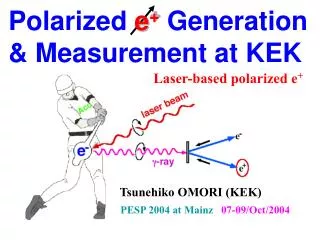
Polarized e+ Generation & Measurement at KEK Laser-based polarized e+ Tsunehiko OMORI (KEK) PESP 2004 at Mainz 07-09/Oct/2004
Collaboration KEK Y. Kurihara, T. Okugi, J. Urakawa, T.Omori Tokyo Metropolitan Univ A. Ohashi Waseda Univ. I. Yamazaki, K. Sakaue, T. Saito, R. Kuroda, M. Washio, T. Hirose National Institute of Radiological Sciences M. Nomura, M. Fukuda
Aug. 2004 International Technology Recommendation Panel choose cold technology for International Linear Collider: ILC.
1) Conceptual Design : GLC We have a design for warm LC Simulation Study 10 CO2 lasers + High Current e- accelerator T. Omori et al., NIM A500 (2003) 232-252 2) Experiment@KEK
1) Conceptual Design : ILC Basic Concept is OK for ILC. Simulation Study Design Study is now under way. 2) Experiment@KEK
1) Conceptual Design : ILC Basic Concept is OK for ILC. Simulation Study Design Study is now under way. 2) Experiment@KEK Today’s talk
Experiment@KEK i) proof-of-principle demonstrations ii) accumulate technical informations: polarimetry, beam diagnosis, …
Experiment@KEK DT = 31 p sec. DT = 31 p sec. DT = 31 p sec.
Experiment@KEK step 1) measure polarization of g-ray step 2) measure polarization of e+
step 1 Measure Polarization of g-ray
Measured Number of g-rays Ng = (1.1± 0.1)x106/bunch in 31 p sec
Measured Asymmetry g A= -0.93± 0.15 % A= 1.18± 0.15 % laser pol. = - 79 % laser pol. = + 79 %
Pol. g-ray Production Done: Mar. 2002 Ng ≈ 1 x 10⁶ /bunch DT(rms) = 31 psec Pol. : g = 88 % (if laser pol. = 100%) (measure Eg > 21 MeV) M. Fukuda et al., PRL 91(2003)164801
step 2 Measure Polarization of e+
Pol. e+ Production Now Under Way Design values Ng = 1 x 10⁷ /bunch (with new laser) Ne+ = 3 x 10⁴/bunch (Ee+ = 25 to 45 MeV) Pol. e+ = 77 % DT(rms) = 31 psec Can NOT measure each e+ Polarimetry ?
Measure e+ polarization : use Bremsstrahlung g-ray g-ray polarized e+ E = 40 MeV Pb conveter
Current Situation Whole hardware: ready with small problems Data taking in April-June: Ng ≈ 1 x 10⁷ /bunch : achieved Pol. e+ production and polarimetry : Preliminary Result
Measured Asymmetry: e+ preliminary e+ spin A= +0.71± 0.23 % e- spin in Iron e+ spin A= -1.1± 0.23 % e- spin in Iron
Problem what-we-want-to-do Fix e+ (laser) pol. Flip magnet pol. ) Calculate A ) Calculate A ) Calculate A reference: A=0 expected Liner
Problem what-we-want-to-do Fix e+ (laser) pol. Flip magnet pol. ) Calculate A ) Calculate A ) Calculate A reference: A=0 expected Liner reason: magnet pol. affect detector gain what-we-did Fix magnet pol. Flip e+ (laser) pol. ) Calculate A ) Calculate A Zero magnet current Not Equal No-polarization, due to residual magnetism Improved magnetic shield of the detector (summer)
Summary 1) Production of pol. g and pol. e+ i) Pol. g: finish 2002 M. Fukuda et al., PRL 91(2003)164801 ii) Pol. e+: now under way. 2) Polarimetry We established polarimetry of short pulse & high intensity g-ray. The same method can be applicable to polarimetry of e+. We got preliminary results. Next run in coming Autumn with improved detector. 3) Liner Collider : ILC Laser-Compton: option for pol. e+ source
here here Capture = 4.1% Pol. = 77%
e- beam laser beam Head-on collision a pair of parabolic mirror