Understanding Binomial and Bernoulli Experiments: A Study Guide
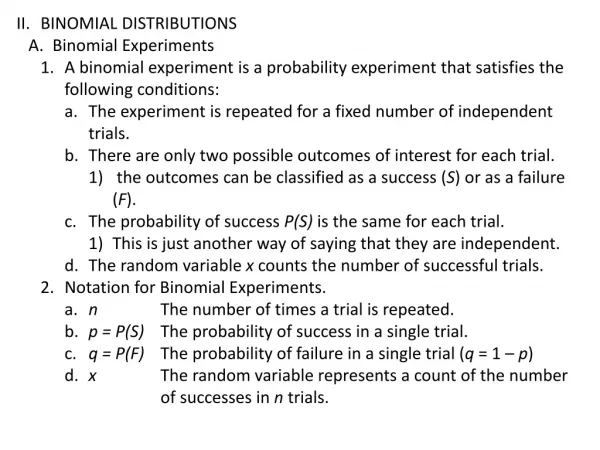
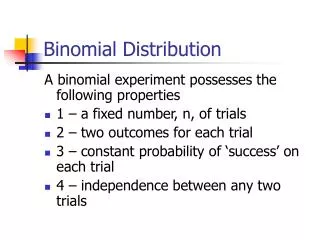
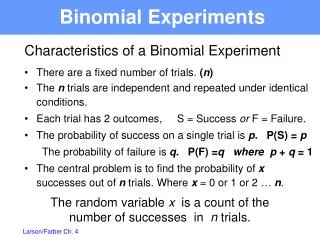
This study guide focuses on Binomial and Bernoulli experiments, pivotal concepts in probability and statistics. It addresses key questions, such as the definition of Bernoulli experiments and their application. The guide walks through the problems associated with binary outcomes, explores the central issues pertaining to binomial experiments, and clarifies misconceptions about their dependency conditions. Ideal for students looking to deepen their understanding of these fundamental statistical principles using textbook references.

Understanding Binomial and Bernoulli Experiments: A Study Guide
E N D
Presentation Transcript
Binomial Experiments Bernoulli Experiments
Study Guide • Use your textbook (pp225…) to answer: • 1. Who was Jacob Bernoulli? • 2. The sort of problems which have exactly 2 possible outcomes is now called:___________? • 3. Describe the central problem of a binomial experiment. • 4. T/F Binomial experiments work only with dependent situations. • 5. Each faculty member at Pepperdine University has been asked about recommending which new car Mr. Micek should purchase… • The # of trials, n = ______? • The # of outcomes possible = _______? • Is this a binomial experiment?
Study Guide sample answers • 1. a 17th century Swiss mathematician who studied binomial experiments extensively. So much so that still they are often called Bernoulli experiments • 2. Binomial experiments • 3. to find the probability of r successes out of n trials • 4. False… only with Independent trials (lg assmption) • 5. # of Pepp faculty/ as many models of cars as there are/ no, since there are more than 2 possibilities