First Evidence for B → D*K ADS Mode: Significance and Asymmetries
70 likes | 197 Vues
This study presents the first evidence for the B → D*K ADS mode, demonstrating a signal with a significance of 4.1σ and improved continuum suppression. The analysis explores the asymmetries in D* decays and variations in signal ratios, providing insights critical for determining the weak phase φ3. Preliminary results show significant values for D* → Dγ, showcasing the effects of interference terms between decay paths. Findings align with Standard Model expectations, revealing important implications for further investigations in B-meson physics.


First Evidence for B → D*K ADS Mode: Significance and Asymmetries
E N D
Presentation Transcript
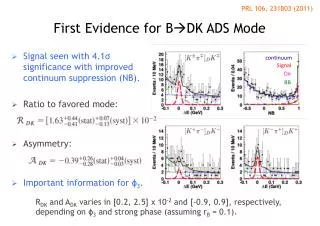
PRL 106, 231803 (2011) First Evidence for BDK ADS Mode • Signal seen with 4.1σsignificance with improvedcontinuum suppression (NB). • Ratio to favored mode: • Asymmetry: • Important information for ϕ3. continuum Signal Dπ BB RDK and ADK varies in [0.2, 2.5] x 10-2 and [-0.9, 0.9], respectively, depending on ϕ3 and strong phase (assuming rB = 0.1).
Preliminary First Evidence for BD*K ADS Mode • Continuum suppressionwith: • Signal seen with 3.5σsignificance for D*Dγ mode. • Ratio to favored mode: • Difference between RDπ0 and RDγ: indication of the effect of the interference term 2rB*rDcos(δB*+δD)cosϕ3 (opposite sign for RDπ0 and RDγ). continuum continuum Signal Signal D*π D*π DK/Dπ DK/Dπ BB BB
Preliminary Asymmetries for BD*K ADS Mode • Asymmetry: • Indication of opposite signfor ADπ0 and ADγ:consistent with expectation.(Opposite strong phasebetween D*Dπ0 and D*Dγ.) • Combining RDπ0, RDγ, ADπ0, and ADγ: indication of negative cos(δB*+δD)cosϕ3 and positive sin(δB*+δD)sinϕ3. Consistent with BD(*)K Dalitz result.
PRL 106, 231803 (2011) Suppressed BDπ, DKπ • Ratio to favored mode: SM expectation: RDπ ~ rD2 = 3.3 x 10⁻³ (HFAG ’10). • Asymmetry: SM expectation: ADπ ~ 0. continuum Dπ DK BB
Preliminary Suppressed BD*π, D*Dπ0/γ, DKπ • Significances are 4.8σ and 4.7σfor π0 and γ modes, respectively. • Ratio to favored mode: • Consistent with the SM:R ~ rD2 = 3.3 x 10⁻³ (HFAG ’10). continuum continuum D*π D*π D*K D*K DK/Dπ DK/Dπ BB BB
Preliminary Asymmetries for BD*π, D*Dπ0/γ, DKπ • Asymmetry: • Consistent with the SM: A ~ 0.