Enhanced Data Management and Analysis for AmeriFlux Network: A New Era of Carbon-Climate Synthesis
The AmeriFlux Network's data management system has shifted towards improved carbon-climate synthesis. By enhancing data availability and quality through collaborative efforts, over 600 site years of data from more than 250 sites can now be accessed. The new database architecture integrates ancillary biological data and allows for robust browsing, mining, and analysis capabilities. Streamlined processes ensure data integrity, eliminating common pitfalls while enabling researchers to conduct comprehensive analyses across different sites. Support tutorials are available for users.

Enhanced Data Management and Analysis for AmeriFlux Network: A New Era of Carbon-Climate Synthesis
E N D
Presentation Transcript
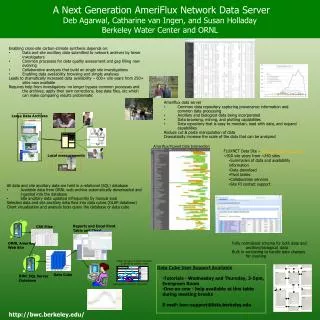
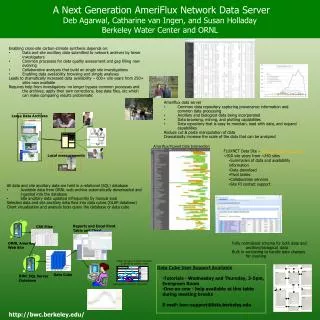
Large Data Archives Reports and Excel Pivot Table and Chart CSV Files ORNL Ameriflux Web Site • Enabling cross-site carbon-climate synthesis depends on: • Data and site ancillary data submitted to network archives by tower investigators • Common processes for data quality assessment and gap filling now evolving • Collaborative analyses that build on single site investigations • Enabling data availability browsing and simple analyses • Leads to dramatically increased data availability – 600+ site years from 250+ sites now available • Requires help from investigators: no longer bypass common processes and the archives, apply their own corrections, lose data files, etc which can make comparing results problematic Local measurements Data Cube BWC SQL Server Database A Next Generation AmeriFlux Network Data ServerDeb Agarwal, Catharine van Ingen, and Susan HolladayBerkeley Water Center and ORNL • Ameriflux data server • Common data repository capturing provenance information and common data processing • Ancillary and biological data being incorporated • Data browsing, mining, and plotting capabilities • Data repository that is easy to maintain, load with data, and expand capabilities • Reduce cut & paste manipulation of data • Dramatically increase the scale of the data that can be analyzed Ameriflux/Fluxnet Data Intersection • FLUXNET Data Site – http://www.fluxdata.org • ~920 site years from ~240 sites • Summaries of data and availability information • Data download • Pivot tables • Collaboration services • Site PI contact support • All data and site ancillary data are held in a relational (SQL) database • Available data from ORNL web archive automatically downloaded and ingested into the database • Site ancillary data updated infrequently by manual load • Selected data and site ancillary data flow into data cubes (OLAP database) • Client visualization and analysis tools query the database or data cube Fully normalized schema for both data and ancillary/biological data Built in versioning to handle data changes for cleaning What’s going on at higher latitudes? (It should be getting colder) • Data Cube User Support Available • Tutorials - Wednesday and Thursday, 3-5pm, Evergreen Room • One-on-one - help available at this table during meeting breaks • E-mail: bwc-support@lists.berkeley.edu Measurements per Month Data is often missing in the winter! http://bwc.berkeley.edu/