Download
1 / 1
10 likes | 135 Vues
Dive into the fascinating world of fractals, specifically focusing on L-systems and their application in generating stunning graphics. This study covers the iterative process of creating Koch islands and snowflakes using grammar, showcasing designs like the Lorenz attractor and Julia sets. Learn how the Rayleigh number influences fractal characteristics and explore self-similarity through carefully crafted examples. Discover the beauty of deterministic and context-free Lindenmayer systems with an emphasis on branching structures, perfect for appreciating the intricate patterns of nature.

E N D
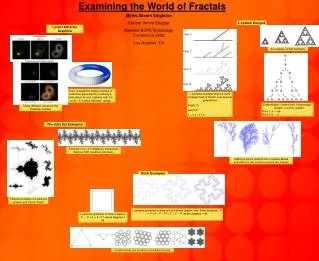
Examining the World of Fractals Koch Examples Lorenz Attractor Graphics L-systems grammar to draw a Koch Island Graphic over three iterations, “F → F + F – F – FF + F + F – F” where degrees = 90 L-systems grammar to draw a square, “F → F + F + F + F” where degrees = 90 Iterations that use the Koch snowflake formula Torus: A doughnut-shaped surface of revolution generated by revolving a circle about an axis coplanar with the circle – A “Lorenz Attractor” design L-system Designs The Julia Set Examples Using different values for the Rayleigh number An example of Self-Similarity Example of a c ≠ 0 imaginary component that has 180º rotational symmetry L-systems example where a trunk emerges from a branch over several generations Angle 10 Axiom F F = F [ + F ] F Deterministic, context-free Lindenmayer system, or a D0L system Rule 1: a → ab Rule 2: b → a Famous example of a Julia set graphic and Cantor Dusts Adding a cursor stack to the L-system allows branching for the creation of plant-like images Myles Akeem Singleton Central Illinois Chapter National BDPA Technology Conference 2006 Los-Angeles, CA