Optimal Algorithms for Topologically Constrained Point Correspondence
10 likes | 162 Vues
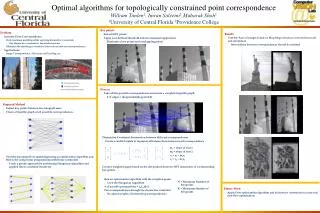
This study presents an innovative method for achieving accurate point correspondence between images with topological constraints. By extracting key SIFT points and applying user-defined thresholds, our approach minimizes overlapping correspondences while maximizing matching efficiency. We utilize a complete bipartite graph to represent potential correspondences and implement optimization techniques such as the Hungarian Algorithm, along with linear programming and disjunctive constraints. The results demonstrate significant improvements in applications like image detection and tracking, utilizing data from close image pairs sourced from Bing Maps.


Optimal Algorithms for Topologically Constrained Point Correspondence
E N D
Presentation Transcript
Optimal algorithms for topologically constrained point correspondenceWilliam Timlen2, Imran Saleemi1,Mubarak Shah11University of Central Florida 2Providence College • Key points • Extract SIFT points • Apply user defined threshold and non maximal suppression • Eliminates close points and overlapping points • Problem • Accurate Point Correspondence • Find maximum matching while applying disjunctive constraints • Our disjunctive constraint is linear intersections • Minimize the matching cost and the intersections between correspondences • Applications: • Image Correspondence, Detection and Tracking, etc. • Results • Test Set: Pairs of images found on Bing Mapswhich are close both in scale and orientation • Intersections between correspondences should be minimal • Process • Take all the possible correspondences and create a complete bipartite graph. • # of edges = (keypoints1)(keypoints2) • Proposed Method • Extract key points between two images/frames • Create a bipartite graph of all possible correspondences. • Find the maximum flow (matching) using an optimization algorithm and then solve using linear programming with linear constraints • I took a greedy approach by performing Hungarian Algorithm and applied linear constraint iteratively • Disjunctive Constraint: Intersection between different correspondences • Create a conflict matrix to represent all intersections between each correspondence • m1 = slope of line 1 • m2 = slope of line 2 • c1 = y1 – m1x1 • c2 = y2 – m2x2 • Create a weighted graph based on the dot product between SIFT descriptors of corresponding key-points • Run an optimization algorithm with the weighted graph • Used the Hungarian Algorithm • # of possible permutations = (nCk)(k!) • Pass correspondences through the disjunctive constraint • Re-adjust weights of intersecting correspondences • N = Maximum Number of Keypoints • K = Minimum Number of Keypoints • Future Work • Apply flow optimization algorithm and disjunctive constraints in a max-cut / min-flow optimization,