Download
1 / 19
200 likes | 832 Vues
Porifera, the phylum comprising sponges, belong to the subkingdom Parazoa and are known for their porous bodies. These simple organisms lack distinct tissues, organs, and nervous systems, existing at the cellular level of organization. With various body plans—Asconoid, Syconoid, and Leuconoid—and diverse subgroups like Hexactinellida and Demospongiae, sponges exhibit fascinating reproductive strategies (asexual and sexual) and efficient filtration feeding methods. Found predominantly in marine environments, they play critical ecological roles and can both act independently or in colonies.

E N D
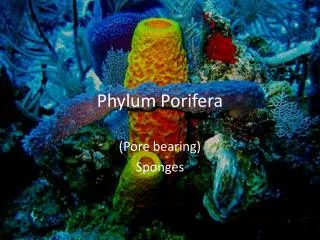
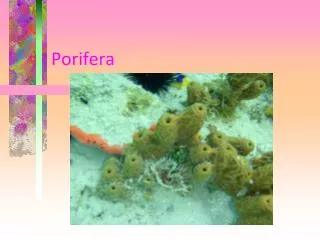
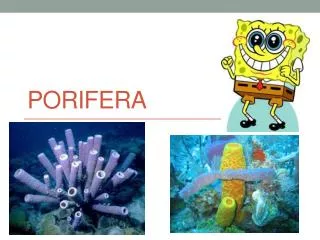
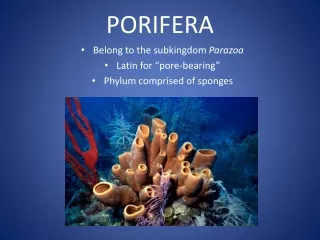
PORIFERA • Belong to the subkingdom Parazoa • Latin for “pore-bearing” • Phylum comprised of sponges
Germ Layers • Porifera lack distinct tissues and organs and, therefore, have no germ layers. • Porifera do have two cellular layers. - Pinacocytes: line the outer surface - Choanocytes: line the interior body
Level of Organization • Porifera have the cellular level of organization. • Cells are specialized to perform different functions, but are not organized into tissues or bodies. • Porifera do not have nervous systems.
Body Cavity Porifera are acoelomates: they have no body cavities. Segmentation Porifera are nonsegmented.
Body plan Asconoid – simplest form, tube or vase shaped, no canals Syconoid – radial canals, more choanocytes, can filter more water Leuconoid – largest, most complex, most numerous, incurrent canals which open into chambers lined with choanocytes Yellow – pinacocytes Red – choanocytes Gray – mesophyl
Subgroup – Hexactinellida • Composed of siliceous spicules (silicon dioxide) • Six rays intersecting at right angles • Only leuconoid forms • Approximately 500 living species • Cannot contract • Conduct electrical pulses across their bodies • Oscula notably large
Subgroup - Demospongiae • Composed of siliceous spicules and/or spongin fibers • 1-4 rays, not at right angles • Only leuconoid forms • Approximately 4750 living species • Most diverse group – variety of growth forms • Tend to be large • More than 90% of Porifera are classified as Demospongiae
Subgroup - Calcarea • Composed of calcareous spicules (calcium carbonate) • 3-4 rays • Has asconoid, syconoid, and leuconoid members • Approximately living 400 species • Often rough textured • Usually small in size
Subgroup - Sclerospongiae • Composed of siliceous spicules, spongin fibers, and calcium carbonate • Only leuconoid forms • Few living species, found only in the West Indies and Pacific • Resemble corals • Contribute to the structure of reefs
Habitat • All porifera are aquatic • Most are marine (only 150 freshwater species) • While hexactinellida live at great depths, calcarea are predominantly found in shallow waters • Demospongiae live in a variety of aquatic environments • Porifera may live independently or in colonies • Porifera are sessile: they attach themselves to rocks, coral, shells, and other substrates
A - require exposed surface - elevated form provides good access to water - attachment area is small portion of total body surface B - use much of surface for attachment - low form allows for crevice dwelling C - utilizes space in the substrate
Asexual Reproduction • Budding - Mitotic cell divisions produce a bud that is pinched off from the parent • Fragmentation - Offspring is formed from a segment of the adult body • GemmuleFormation – Occurs in freshwater sponges; internal buds called gemmules are formed within the adult body and eventually develop into individuals
Sexual Reproduction - Hermaphroditic Each adult possesses both male and female sex organs and can act as either sex in the process: • Spermatozoa are released into the water by a sponge and taken into the pore systems of a neighbouring sponge • The spermatozoa are captured by choanocytes which then transform into specialized cells that carry the spermatozoa to the eggs • The fertilized eggs are released into the water • The larvae may settle immediately or may drift for some time
Suspension Feeding • Choanocytes contain flagella that drive water through the sponge, trapping bacteria and other food • Nutrients are distributed among the cells of the mesohyl that facilitate the functioning of feeding, respiration, and reproduction • The flow of water inside a sponge in unidirectional: water is drawn in through tiny pores called ostia and exits through large openings called oscula • The water flow not only provides food, but also oxygen and means for waste removal
Amoebocyte – functions in digestion • Choanocyte – lines interior body • Flagellum – creates current of water • Mesohyl – gelatinous layer • Osculum – large exterior opening; water outlet • Ostium – small exterior pore; water inlet • Pinacocyte – lines outer surface • Porocyte – tubular cell, constitutes a pore • Spicule – skeletal component, provides support • Spongocoel – central chamber
Exception - Cladorhizidae • These carnivorous sponges feed by capturing and digesting small crustaceans Harp sponge – barbed hooks
Regeneration • If the cells of a sponge are separated, they can reassemble and regenerate into a complete and functioning organism Regeneration video