Understanding Cyclohexane Chair Conformations and Bonding Patterns
This article explores the structural nuances of cyclohexane, emphasizing its chair conformations and the differentiation between equatorial and axial bonds. We discuss the concept of tetrahedral carbons in cyclohexane, provide insights on numbering carbons, and delve into the various disubstituted isomers, including both trans and cis configurations. With a focus on conformational isomers, the relationship between equatorial and axial substituents is addressed, enriching the understanding of molecular geometry. Ideal for students and chemistry enthusiasts.

Understanding Cyclohexane Chair Conformations and Bonding Patterns
E N D
Presentation Transcript
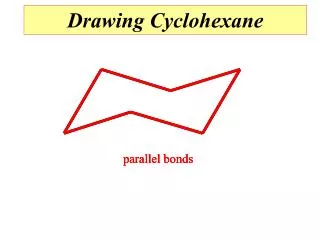
parallel bonds parallel bonds parallel bonds Drawing Cyclohexane
equatorial bonds axial bonds
4 6 5 1 3 2 Numbering Cyclohexane Start anywhere and number consecutive carbons.
Tetrahedral Carbons in Cyclohexane 1 tetrahedral carbon
2 tetrahedral carbon
3 tetrahedral carbon
4 tetrahedral carbon
5 tetrahedral carbon
6 tetrahedral carbon
4 6 5 1 3 2 6 axial bonds (green) (3 straight up; 3 straight down) 6 equatorial bonds (blue) (3 slightly up; 3 slightly down)
Disubstituted Isomers of Cyclohexane 1 2 two equatorial substituents (purple) name of cpd: trans-1,2-di . . . cyclohexane and . . .
1 2 two axial substituents (purple) name of cpd: trans-1,2-di . . . cyclohexane are conformational isomers of one another. Also, . . .
1 3 two equatorial substituents on carbons 1 & 3 name of cpd: cis-1,3-di . . . cyclohexane and . . .
1 3 two axial substituents on carbons 1 & 3 name of cpd: cis-1,3-di . . . cyclohexane) are conformational isomers of one another. Furthermore, . . .
4 1 two equatorial substituents on carbons 1 & 4 name of cpd: trans-1,4-di . . . cyclohexane) and . . .
1 4 two axial substituents on carbons 1 & 4 name of cpd: trans-1,4-di . . . cyclohexane are conformational isomers of one another.
the other chair conformation hold red bonds in a plane flip this C above the plane flip the other C below the plane Chair Conformations of Cyclohexane you get
number carbons in this conformation 6 4 5 2 3 1 5 number the same carbons in this conformation 6 1 3 4 2
6 4 5 C4 is above the plane, while... 2 3 1 C4 is below the plane. 5 6 C1 is below the plane and ... 1 3 4 C1 is above the plane and... 2 given the plane formed by carbons 2, 3, 5, and 6
6 4 equatorial bonds here. 5 axial bonds here become ... 2 3 1 5 1 axial bonds here, and... 6 equatorial bonds here become ... 3 4 2
4 6 5 1 3 2 above below below below above above Equatorial bonds alternate being above and below the axial bonds on a given carbon atom and . . .
4 6 5 1 3 2 above above above below below below axial bonds alternate being above and below the equatorial bonds on a given carbon atom.
The End And what a nifty cool story it was . . .