Exploring the Rich Contributions of Islamic Literature, Architecture, and Science
Islamic culture has made significant contributions across various fields. The Quran stands as a cornerstone of Islamic literature, influencing Arabic poetry and storytelling, exemplified by "A Thousand and One Nights." Architects blended influences to create stunning mosques, such as the Alhambra in Spain, showcasing intricate designs. Additionally, Islamic scholars advanced mathematics, as seen in Al-Khwarizmi’s work on algebra, and made groundbreaking strides in medicine and astronomy, notably through the astrolabe. Islamic art, adhering to religious guidelines, emphasizes calligraphy and geometric design.

Exploring the Rich Contributions of Islamic Literature, Architecture, and Science
E N D
Presentation Transcript
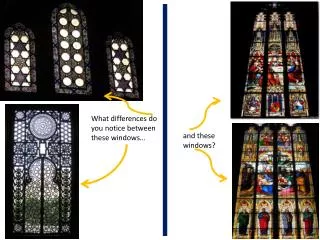
What differences do you notice between these windows… and these windows?
Literature The Quran (Koran) was a major contribution to Islamic literature and is the standard for all Arabic literature and poetry. Fictional adventure stories also played an important part in Islamic literature. The most famous is A Thousand and One Nights (also called The Arabian Nights). It’s tales include Aladdin and his magic lamp.
Architecture Islamic architecture is a blend of Arab, Turkish, and Persian traditions. Mosques were the most important buildings of the Arab World. Mosques featured minarets, domes, and walls decorated with gold and mosaics (small tiles). One of the finest examples of Islamic architecture is the Alhambra Palace in Granada, Spain. Blue Mosque, Istanbul
Math Islamic Scholars made contributions to mathematics and the natural sciences. Al-Khwarizmi, a Muslim mathematician, wrote a book about al-jabr, the Arabic word for algebra. 3x=15
Science The Muslims made major advances in astronomy through scientific observation. They perfected the astrolabe, an instrument used by sailors to determine their location by observing positions of stars and planets. The astrolabe helped later explorers like Christopher Columbus.
Medicine Islamic doctors developed advanced techniques like surgery with anesthesia. The most famous Muslim doctor, al-Razi studied infectious diseases. Cordoba, Spain became known for its medical care, and patients came from all over the world to Cordoba for treatment.
Art The Prophet Mohammad and the Quran forbid any portrayals of himself or other living things, especially in mosques. Therefore, Islamic art does not generally include representations of people or animals. Instead, Islamic art focuses on calligraphy (the art of beautiful handwriting), geometric shapes, and tessellations. Calligraphy Geometric shapes Tessalations Alhambra Palace, Granada, Spain