Impact of Nicorandil on Angina: IONA Presentation 2001
Explore the impact of nicorandil on angina treatment outcomes based on a study presented by Henry J. Dargie. This presentation discusses the importance of nicorandil in reducing major coronary events and improving cardiovascular health in patients with chronic stable angina.

Impact of Nicorandil on Angina: IONA Presentation 2001
E N D
Presentation Transcript
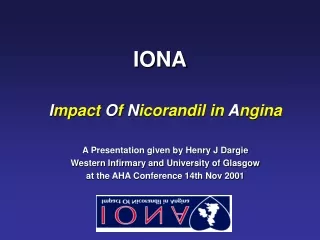
IONA Impact Of Nicorandil in Angina A Presentation given by Henry J Dargie Western Infirmary and University of Glasgow at the AHA Conference 14th Nov 2001
IONA • Background : • Angina is common - affects over 10% of men and women over 60 • Angina is disabling - quality of life can be poor • Angina affects outcome variably - 3% to 20% annual rate of cardiac events
Anti anginal : nitrates beta blockers Ca++ channel blockers nicorandil Disease modifying : anti-platelet statin ACE inhibitors IONA- current medical treatment of angina
IONA • Objective : To investigate the impact of nicorandil on outcome in patients with angina of effort - when added to existing treatments
IONA • Primary Hypothesis : Treatment with nicorandil will reduce the incidence of the primary endpoint by 25% • Primary End Point : Coronary Heart Disease Death + Non fatal Myocardial Infarction + Unplanned Hospitalisation for Cardiac Chest Pain
IONA • Secondary End Point : • Coronary Heart Disease Death • + • Non Fatal Myocardial Infarction
IONA • Exploratory Analyses : • All cause mortality • All cardiovascular events
IONA • Design and Methodology : • Double blind, randomised controlled trial of nicorandil versus placebo • 10 mg bd increasing to 20 mg bd after 2 weeks • Higher risk patients on existing medication • not being actively considered for revascularisation • Conducted exclusively in the UK • recruitment from hospital and primary care • Analysis was by intention to treat
IONA • Inclusion criteria • Men or women • Stable angina with high risk features • Need for regular oral anti anginal medication (long acting nitrate, beta blocker or calcium channel blocker)
IONA • Recruitment and follow up • 5126 patients recruited • 2561 (P), 2565 (N) • Average follow up of 1.6 years • (1- 3 years)
Male (%) 76 Smoker (%) 16 Previous MI (%) 66 PTCA/CABG (%) 34 Diabetes (%) 8 Hypertension (%) 46 PVD (%) 12 Stroke/TIA (%) 7 Age (years) 67 SBP (mmHg) 138 DBP (mmHg) 79 CCSF (%) I 27 II 62 III 11 IV 1 IONA Baseline characteristics
Antiplatelet 88 -blocker 56 Ca-antagonist 55 Nitrate 86 Statin 57 ACE inhibitor 29 Insulin 3.4 Hypoglycaemic 2.1 IONA Baseline therapy (%)
(RRR = 17%, P = 0.014) Nicorandil Placebo
Nicorandil (RRR = 21%, P=0.068) Placebo
(RRR = 13%, P = 0.27) Nicorandil Placebo
(RRR = 15%, P = 0.025) Nicorandil Placebo
IONA • Summary • In patients with chronic stable angina: • Nicorandil significantly reduced the incidence of major coronary events and all cardiovascular events • IONA is the first large scale clinical trial to report on the effects of a specific anti - anginal medication on clinical outcome
Anti anginal : nitrates beta blockers Ca++ channel blockers nicorandil Disease modifying : anti-platelet statin ACE inhibitors nicorandil IONA-future medical treatment of angina