Download
1 / 14
150 likes | 276 Vues
This document explores the integration of TCP over ATM networks, focusing on the mapping of protocol layers and performance considerations. It discusses challenges in utilizing UBR (Unspecified Bit Rate) and ABR (Available Bit Rate) services, including issues related to segment packing, overhead, and potential resource wastage due to packet loss. The document proposes strategies such as Partial Packet Discard (PPD) and Early Packet Discard (EPD) for improving throughput. Additionally, it highlights how ABR enhances flow control, maximizing throughput, fairness, and efficiency in TCP connections.

E N D
TCP over ATM Dr. Abdulaziz Almulhem
Agenda • TCP over ATM • Possible mapping (UBR/ABR) • Performance over UBR • Performance over ABR 2
TCP over ATM • TCP is very popular • ATM provides WAN connectivity for high speed networking 3
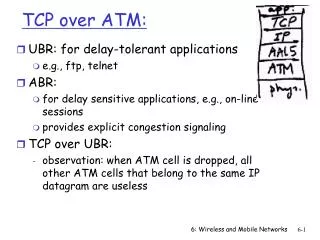
Protocol Mapping • TCP • IP • AAL5: mapping higher layer PDUs into ATM cells • Convergence Sublayer (CS): services to higher layers • Segmentation & Reassembly Sublayer (SAR): packing and unpacking of data • ATM 4
TCP over UBR • Problem of running TCP over ATM • TCP segments are packed into ATM cells • Overhead • If a cell is lost, segment is useless • Resource waste • Undesirable delays • Segment size impacts the throughput • Lager segments tolerate more to discard 6
Packet Discard • To increase throughput, ATM switch buffer sizes can be increased (?) • Alternatively, ATM switches can be smart and reduce waste via discard strategies: • Partial Packet Discard (PPD) • Early Packet Discard (EPD) 7
PPD • If a cell belonging to a packet is dropped, subsequent cells are also dropped • The last cell is not dropped since it designates the end of packet and should be carried all the way to destination • Still, there is some waste! 8
EPD • Instead of buffering partial packets, a packet size is checked before it is accepted • If the packet size is less than the remaining buffer capacity, then accept • However if the packet size is larger than free buffer, packet is dropped. 9
TCP over ABR • ABR provides flow control • TCP can utilize this control • ABR will increase throughput and maximize utilization • Also ABR maximizes fairness and sharing. 11
ABR Flow Control • Two modes: • Binary mode: a switch indicates a congestion where a source has to change its rate up/down incrementally. • Explicit rate mode: a switch will run an algorithm to find the rate at which the source should send data. 12
TCP over ABR, again… • Two modes of operation: • Window-limited mode: ABR will provide the maximum possible rate a source can transmit with. However TCP will slowly start and congestion window will grow to use all rate. • Rate-limited mode: once congestion occurs, rate will be limited and TCP acks rate will be reduced that will reduce the rate at which TCP source sends segments. 13
Performance • ABR is very sensitive to parameters which in turn will affect performance and fairness • ABR could be comparable to UBR • ABR needs smaller buffer sizes from the switches to guarantee higher throughput than UBR which requires buffering proportional to number of TCP connections 14