

SOCRATES-PLATO-ARISTOTLE
E N D
Presentation Transcript
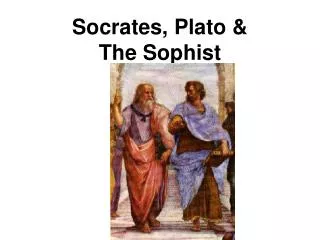
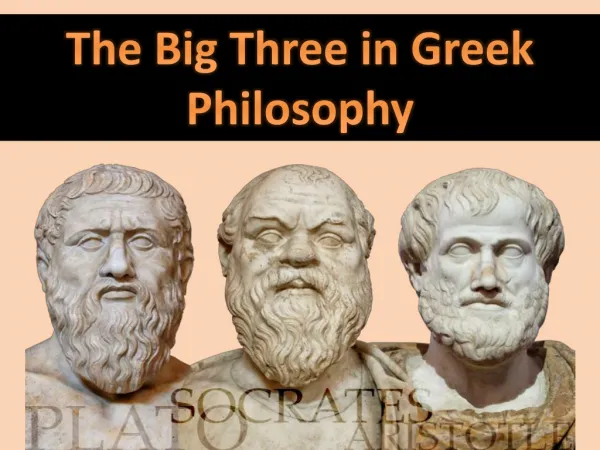
The Big Three in Greek Philosophy PLATO SOCRATES ARISTOTLE
SOCRATES ---------- QUICKFACTS ---------- NAME: Socrates OCCUPATION: Philosopher BIRTH DATE: c. 470 BCE DEATH DATE: c. 399 BCE (approx. age 71 years old) PLACE OF BIRTH: Athens, Greece PLACE OF DEATH: Athens, Greece
SOCRATES • Ancient Greek thinker who laid the early foundations for Western philosophical thought. • We know of his life through the writings of his students, includingPlato and from the Memorabilia of Xenophon. • Famous for his view of philosophy as a pursuit proper and necessary to all intelligent men, he is one of the great examples of aman who lived by his principles even though they ultimately cost him his life. • His "Socratic method" laid the groundwork for Western systems of logic and philosophy. * The Socratic method is method of investigating problems through dialogue discussions.
SOCRATES: Socratic Method SOCRATIC METHOD INVOLVES 4 WAYS SUCH AS: • Socratic Irony- Socrates pretended that he knew no answers. His assumed ignorance or willingness to learn from others was the background for adroit questioning to reveal the truth or expose the error of the answers he received. • Definition- the initial question usually required the definition of the concept or the meaning of an idea. • Analysis- includes an affirmation or negotiation of a certain idea or concept; even the relation or the difference of one idea to another. • Generalizations- After examining all the particular applications, Socrates persuaded his students to reason, from particular to general, or by process of induction to reach general conclusions.
SOCRATES: HisEarly Years • Socrates was the son of Sophroniscus, an Athenian stone mason and sculptor, and Phaenarete, a midwife. • Because he wasn't from a noble family, he probably received a basic Greek education and learned his father's craft at a young age. • It is believed Socrates worked as mason for many years before he devoted his life to philosophy. • Socrates married Xanthippe, a younger woman, who bore him three sons—Lamprocles, Sophroniscus and Menexenus. • He participated in three military campaigns during the Peloponnesian War against Sparta, at Delium, Amphipolis, and Potidaea, where he saved the life of Alcibiades, a popular Athenian general.
SOCRATES: As Philosopher • Socrates believed that philosophy should achieve practical results for the greater well-being of society. • He attempted to establish an ethical system based on human reason rather than theological doctrine. • He pointed out that : • Human choice was motivated by the desire for happiness. • Ultimate wisdom comes from knowing oneself. • The more a person knows, the greater his or her ability to reason and make choices that will bring true happiness.
SOCRATES: His Doctrines • KNOWLEDGE IS VIRTUE. In order to live a good life, oe must question oneself and others as to what human exellence really is. “Knowledge is a virtue and ignorance is a vice.” • THE SOCRATIC IRONY. A man who thinks he already has the answers is not likely to make much of a search for the truth. The first step on the road to knowledge is the recognition of our ignorance. • THE ART OF GOOD LIVING. In leading the life of a human being there are certain limits or laws which must be observed in order to lead a good life.
SOCRATES: Execution and Death • Socrates’ iconolastic attitude didn’t sit well with everyone, and at the age of 70, he was charged with heresy and corruption of local youth. • Convicted, he carried out death sentence by drinking a mixture of poison hemlock. • Before Socrates' execution, friends offered to bribe the guards and rescue him so he could flee into exile. He declined, stating he wasn't afraid of death, felt he would be no better off if in exile and said he was still a loyal citizen of Athens, willing to abide by its laws, even the ones that condemned him to death.
PLATO ---------- QUICKFACTS ---------- NAME: Plato a.k.aAristocles OCCUPATION: Philosopher, Writer BIRTH DATE: c. 428 BCE DEATH DATE: c. 348 BCE (approx. age 80 years old) PLACE OF BIRTH: Athens, Greece PLACE OF DEATH: Athens, Greece
PLATO • A classical Greek philosopher, mathematician, writer if philosophical dialogues, and a founder of the Academy in Athens- the first institution of higher learning in the Western world. • Along with his mentor, Socrates, and his student, Aristotle,Plato helped to lay foundations of natural philisophy, science and western philosophy. • His writings explored justice, beauty and equality, and also contained discussions in aesthetics, political philosophy, theology, cosmology, epistemology and the philosophy of language.
PLATO: His Early Years • Both of his parents came from the Greek aristocracy. Plato's father, Ariston, descended from the kings of Athens and Messenia. His mother, Perictione, is said to be related to the Greek statesman Solon. • Plato's father died when he was young, and his motherremarried her uncle,Pyrilampes, a Greek politician and ambassador to Persia. • As a young man, Plato experienced two major events that set his course in life. • One was meeting the great Greek philosopher Socrates. • The other significant event was the Peloponnesian War between Athens and Sparta.
PLATO: As Philosopher • At the age of 20, he came under the tutelage of Socrates; having a profound admiration for him because of the teaching he had received. • He said “ I thank the gods for having been born a Greek and not a foreigner, a man and not a woman, free and not a slave, but above all for having been born during the time of Socrates.” • Plato writes in his own voice on the central ideals of justice, courage, wisdom and moderation of the individual and society. • The Republic was written during this time with its exploration of just government ruled by philosopher kings.
PLATO: The Platonic Dialect • Plato was more interested in the question of meaning. For ex. • Why do we give one name to some things ad a different name to others? • What does it mean to give the same name to two different things? • For Plato, a name is just an agreed-on sign or sound to what we are thinking of. • He says ” will include both the changeable and the unchangeable in his definition of being.”
PLATO: View of Man and Soul • For him, human soul is divided into 3 parts: • Reason (Rational part) • guide the other parts of the Soul by virtue of its knowledge or understanding • Passion (Spirited part) • to enforce the decision of the rational part (Reason) • Desire (Appetitive part) • To obey or follow the rational and the spirited parts in the satisfaction of desires.
PLATO: Final Years • Plato's final years were spent at the Academy and with his writing. The circumstances surrounding his death are clouded, though it is fairly certain that he died in Athens around 348 B.C., when he was in his early 80s. • Some scholars suggest that he died while attending a wedding, while others believe he died peacefully in his sleep. • Plato's impact on philosophy and the nature of humans has had a lasting impact far beyond his homeland of Greece. His work covered a broad spectrum of interests and ideas: mathematics, science and nature, morals and political theory.
ARISTOTLE ---------- QUICKFACTS ---------- NAME: Aristotle OCCUPATION: Philosopher BIRTH DATE: 384 BCE DEATH DATE: 322 BCE (age 62) PLACE OF BIRTH:Stagira, Chalcidice, Greece PLACE OF DEATH:Chalcis, Euboea, Greece
ARISTOTLE • Ancient Greek philosopher who became a student of Plato at the age of 17. • In 338, he began tutoring Alexander The Great. • In 335, Aristotle founded his own school, the Lyceum, in Athens, where he spent most of the rest of his life studying, teaching and writing. • The Lyceum had been dedicated to AppolloLyceusfrom where it took its name. • The Lyceum is known for the natural sciences. • He wrote on many subjects like physics, metaphysics, poetry, theatre, music, logic, rhetoric, politics, government, ethics, biology and zoology.
ARISTOTLE: Doctrine of Form and Matter • Aristotle explained that all the things in the world are made up of 2 principles: • Form – that makes them what they are, gives them their basic way of being. • Limitation – a principle which limits form, restricts it, which makes it individual, quantified, existing in a definite time and place. • Aristotle gave the name matter. Thus, he stated that the body is matter to the soul, and the soul is the form to the body known as the principle of hylemorphism.
ARISTOTLE: As Philosopher and Writer • One of the main focuses of Aristotle’s philosophy was his systematic concept of logic. • The initial process involved describing objects based on their characteristics, states of being and actions. • Aristotle wrote an estimated 200 works, most in the form of notes and manuscript drafts. They consist of dialogues, records of scientific observations and systematic works. Of Aristotle’s estimated 200 works, only 31 are still in circulation. • Aristotle’s major writings on logic include Categories, On Interpretation, Prior Analytics and Posterior Analytics. In them, he discusses his system for reasoning and for developing sound arguments.
ARISTOTLE: Death and Legacy • In 322 BC, just a year after he fled to Chalcis to escape prosecution under charges of impiety, Aristotle contracted a disease of the digestive organs and died. • Aristotle’s work influenced ideas from late antiquity all the way through the Renaissance. • Aristotle’s influence on Western thought in the humanities and social sciences is largely considered unparalleled.
GET READY FOR A QUIZ ¼ Yellow Pad
QUIZ 1. He is an ancient Greek thinker who laid the early foundations for Western philosophical thought. 2. This is method of investigating problems through dialogue discussions. 3. Socrates died because he drinks the poison named __________. 4. He is a Greek philosopher and the founder of The Academy in Athens- first institution of higher learning in the Western world. 5-7. According to Plato,the human soul is divided into 3 parts. Enumerate these parts. 8. What is Plato’s real name? 9. He founded his own school, the Lyceumin Athens. 10. The Lyceumhad been dedicated to _________ from where it took its name.