The Ancient World
Explore the fascinating journey of human civilization from 100,000 years ago to the dawn of the Bronze Age. Beginning in Africa, early humans spread across Asia and Europe as hunters and artists, leaving behind remarkable cave art in locations like Lascaux, France. As societies evolved, they established megalithic structures like Stonehenge and laid the foundations of agriculture. The Sumerians pioneered writing and monumental architecture in Mesopotamia, while Egypt flourished under the reign of powerful pharaohs. Discover the rich tapestry of early human achievements and cultural developments.

The Ancient World
E N D
Presentation Transcript
First Humans • 100,0000 years ago. • From Africa to Asia, to Europe • Hunters • Worshipped forces of nature
Paleolithic • 40,000-8,000 B.C. • Cave artists • Lascaux, France—bulls, humans • Caves used for ritual ceremonies
Neolithic • 8000-2300 B.C. • Megalithic structures—Stonehenge • Post-and-lintel structures aligned with astronomical prositions
Bronze Age • 2300-1000 B.C. • Began to cultivate the land • Civilization in Mesopotamia
Mesopotamia • Present-day Iraq • The arts, writ6ing and law flourished • Empires dominated the Near East and northern Africa
The Sumerians • 3500 B.C. • First people to use writing • Constructed monumental buildings • Music • Religion: violence • Ziggurats: pyramids with steps to the hereafter
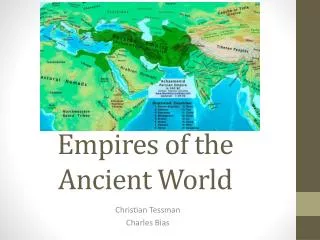
Empires of the Near East • Gilgamesh: hero-king of the Old Babylonians • Great Flood also recounted in the Hebrew Bible • Hammurabi’s legal code • Assyrians conquered lower Egypt • Nebuchadnezzar II – Ishtar Gate • Persians: Darius’ palace at Persepolis • Persepolis fell to Alexander the Great
Egypt: Religion and Society • Polytheism • Pyramids of Giza • Belief in the immortality of the spirit • Treasures buried to ensure happiness after death
The Arts of Egypt • Akhenaten: cult of the god Aten • Established court at Amarna with his queen Nefertiti • Intimacy in the pictorial depiction of humans • Tutankhamen: restores cult of Amon-Re • Ramesses II: monumental, richly-decorated tombs • Nefertari: his wife helped expand empire
Decline of Egypt • Kush empire • Assyrians • Persians • Alexander the Great: Hellenistic culture
The Indus Valley • 2600-1500 B.C. • Unfortified cities • System of writing, terracotta sculpture • Aryans conquered 1500 B.C. • Vedas: religious texts • Hinduism
China • The Bronze Age • Shang dynasty (1700-1100 B.C.) • Carved jade, cast bronze • Zhou (1100-221 B.C.)
Minoan Civilization • Crete (2500-1250 B.C.) • Palace-cities • Artisans: jewelry, figurines • Women unusually free and equal
Mycenaean Civilization • Greek mainland (1600-1150 B.C.) • Mycenaens: warriors and pirates • Treasure found in Mycenae includes the “Mask of Agamemnon” • After Trojan War, Mycenae fell