Understanding Atomic Number and Cobalt's Unique Properties
This lesson delves into the concept of atomic number, defined as the number of protons in an atom, which gives each element its unique identity. We will also discuss mass number and isotopes, enhancing our understanding of atomic structure. Additionally, we'll focus on cobalt (Co), element number 27, known for its hardness and use in steel alloys, drills, and machine bits. Cobalt compounds, often blue in color, have applications in glass tinting. The radioactive isotope 60Co, found in nuclear fallout, will also be explored.

Understanding Atomic Number and Cobalt's Unique Properties
E N D
Presentation Transcript
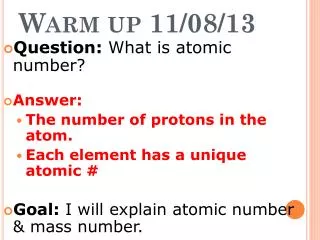
Warm up 11/08/13 • Question: What is atomic number? • Answer: • The number of protons in the atom. • Each element has a unique atomic # • Goal: I will explain atomic number & mass number.
ELEMENT OF THE DAY • 27 – Cobalt – Co • Cobalt steel is one of the hardest steel alloys and is used in drills and machine bits. • Cobalt compounds are often blue, and are used to tint glass. • 60Co is a highly radioactive version of cobalt that is present in nuclear fallout.
Bellwork / Fav Fri • Atomic Number • Mass number & Isotopes • M & M reminder! • Homework • pg 21-24 • Holiday (red & green) pretzel or mint M&Ms for extra credit Agenda