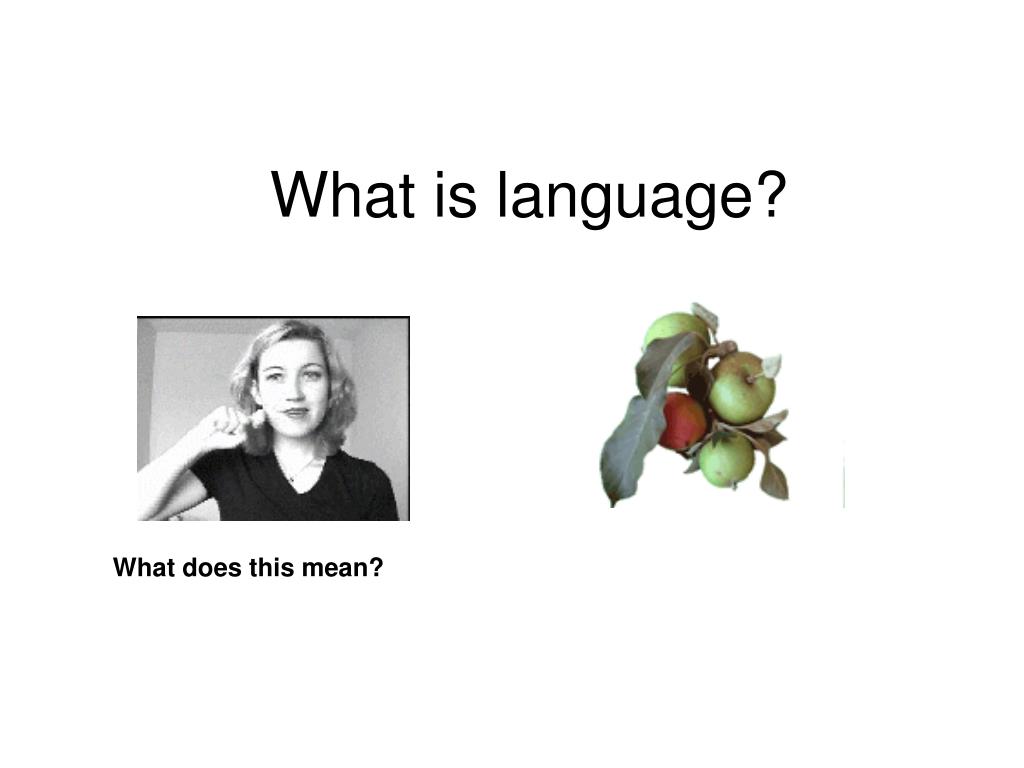
What is language?. What does this mean?. How do we distinguish between language and non language?. Language is rule governed Language is intended Language is creative and open ended. Language is rule governed. Examples of rules……….. Grammar
Une image / un lien ci-dessous est fourni (tel quel) pour télécharger la présentation
Politique de téléchargement : le contenu du site vous est fourni TEL QUEL pour votre information et votre usage personnel ; il ne peut être vendu, concédé sous licence ni partagé sur d’autres sites sans l’accord de son auteur.Le contenu vous est fourni TEL QUEL, pour votre information et votre usage personnel uniquement.Téléchargez la présentation en cliquant sur ce lien.Lors du téléchargement, si vous ne parvenez pas à télécharger une présentation, l’éditeur a peut-être supprimé le fichier de son serveur.Pendant le téléchargement, si vous ne parvenez pas à obtenir une présentation, le fichier a peut-être été supprimé par l’éditeur.
Language is rule governed Examples of rules……….. • Grammar • Doesn’t matter what rules are so long as everyone follows them.
Language is creative and open-ended • The rules of grammar and vocabulary allow us to make an almost infinite number of grammatically correct sentences • New words being invested all the time • Think of newly invented words ladettes text bumsters metrosexual
The problem of meaning…. The montillation of traxoline It is very important that you learn about Traxoline. Traxoline is a new form of Zionter. It is montilled in Ceristanna. The Ceristannians gristerate large amounts of fevon and then bracter it into quasel traxoline. Traxoline may well be one of our most lukized snezlaus in the future because of our zionter lescelidge.
The problem of meaning…. The montillation of traxoline It is very important that you learn about Traxoline. Traxoline is a new form of Zionter. It is montilled in Ceristanna. The Ceristannians gristerate large amounts of fevon and then bracter it into quasel traxoline. Traxoline may well be one of our most lukized snezlaus in the future because of our zionter lescelidge. • What is traxoline? • Where is traxoline montilled? • How is traxoline quaselled? • Why is it important to know about traxoline?
You can answer the questions although you have no idea what the words mean!! • If you don’t know the meaning of key words in a sentence you will not understand it. • Traxoline is a new form of Zionter – do we know this is true? Important because you must know what a sentence means before you can decide whether or not it is true.
Definition theory Define as precisely as you can the following 3 words i. Triangle ii. Table iii. Love
Problems! • Only mathematical words can be definded precisely • Definitions depend on using other words! • In order to stop being trapped in an endless circle of words, language must surely connect with the world.
Denotation theory • A meaningful words “stands” for something, whereas a meaningless word does not
Jabberwocky Twas brillig, and the slithy toves Did gyre and gimble in the wabe: All mimsy were the borograoves’ And the mome raths outgrabe.
Problems • Can you think of words which would be difficult to define by finding something they “stand for”?
Problems • Can you think of words which would be difficult to define by finding something they “stand for”? • Multiplication, freedom, wisdom?
Problems! • Denotation theory does not work with abstract words • Even a word like “Einstein” cannot literally be Einstein because it would become meaningless when he died.
Image Theory • The meaning of a word is the mental image it stands for
1. Vagueness Without thinking too much, write down a figure for the following; • John lives near school. How close does he live? • Janet is a heavy smoker. How many cigarettes a day does she smoke? • Mr Smith is middle- aged. How old is he? • Nafisha’s mother is rich. How much money does she have in the bank?