Applying Digital Library Metadata Standards
Applying Digital Library Metadata Standards. Jenn Riley Metadata Librarian IU Digital Library Program. Everything you need to know about metadata on one slide. Metadata is one view of a resource It’s more than cataloging It’s an essential part of any digital library project

Applying Digital Library Metadata Standards
E N D
Presentation Transcript
Applying Digital Library Metadata Standards Jenn Riley Metadata Librarian IU Digital Library Program
Everything you need to know about metadata on one slide • Metadata is one view of a resource • It’s more than cataloging • It’s an essential part of any digital library project • The planning is as important as the implementation • Must choose the right tool for the job • There are lots of acronyms PALNI Metadata Workshop
Well, not really… • “Metadata” means many different things • It involves applying traditional library principles to new environments • These new environments are diverse • Many of them have been developed for specific knowledge domains • Metadata planning requires thinking abstractly • There is always more to learn PALNI Metadata Workshop
Many definitions of metadata • “Data about data” • “Structured information about an information resource of any media type or format.” (Caplan) • “Any data used to aid the identification, description and location of networked electronic resources.” (IFLA) • …etc. PALNI Metadata Workshop
More definition • Other characteristics • Structure • Control • Origin • Machine-generated • Human-generated • Data vs. metadata vs. meta-metadata • Used in many different environments PALNI Metadata Workshop
Metadata and cataloging • Depends on what you mean by metadata and cataloging! • But, in general: • Metadata is broader in scope than cataloging • Much metadata creation takes place outside of libraries • Good metadata practitioners use fundamental cataloging principles in non-MARC environments • Metadata created for many different types of materials • Metadata is NOT only for Internet resources! PALNI Metadata Workshop
Some uses of metadata • By information specialists • Describing non-traditional materials • Cataloging Web sites • Navigating digital objects • Managing digital objects long-term • Managing corporate assets • By novices • Preparing Web sites for search engines • Describing Eprints • Managing personal CD collections PALNI Metadata Workshop
Building “Good digital collections”* • Interoperable – with the important goal of cross-collection searching • Persistent – reliably accessible • Re-usable – repositories of digital objects that can be used for multiple purposes *Institute for Museum and Library Services. A Framework of Guidance for Building Good Digital Collections. Washington, D.C.: Institute for Museum and Library Services, November 2001. http://www.niso.org/framework/Framework2.html PALNI Metadata Workshop
Building “Good digital collections” • Interoperable – with the important goal of cross-collection searching • Persistent – reliably accessible • Re-usable – repositories of digital objects that can be used for multiple purposes Good metadata promotes good digital collections. PALNI Metadata Workshop
Metadata in digital library projects • Searching • Browsing • Display for users • Interoperability • Management of digital objects • Navigation PALNI Metadata Workshop
Some types of metadata PALNI Metadata Workshop
Metadata in practice PALNI Metadata Workshop
Creating descriptive metadata • Digital library content management systems • ContentDM • ExLibris Digitool • Greenstone • Library catalogs • Spreadsheets & databases • XML PALNI Metadata Workshop
Creating other types of metadata • Technical • Stored in content management system • Stored in separate Excel spreadsheet • Structural • Created and stored in content management system • METS XML • GIS • Using specialized software • Content markup • In XML PALNI Metadata Workshop
Implementing metadata in digital library projects • Levels of control • Planning your project • Choosing standards • Best practices • Thinking about interoperability PALNI Metadata Workshop
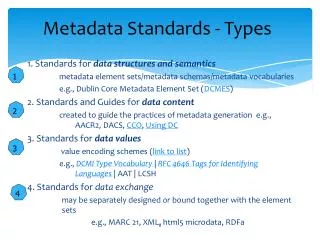
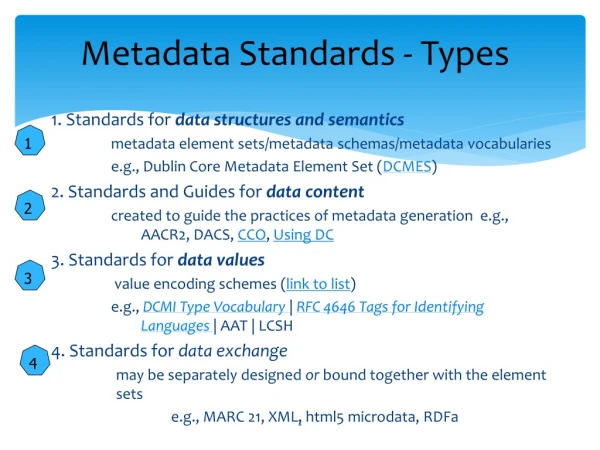
Levels of control • Data structure standards (e.g., MARC) • “Buckets” of information (fields) • Both label and scope important • Data content standards (e.g., AACR2) • Selection, structure and formatting of value within a field • There are others as well • Standards don’t always fall neatly into one category PALNI Metadata Workshop
When there’s no data content standard… PALNI Metadata Workshop
Planning your project • Work collaboratively with technical staff • Think beyond your local system • Commit to do it right the first time • Assess • Materials • Currently existing metadata • Capabilities of your software PALNI Metadata Workshop
Assessing materials for ease of metadata creation • Number of items? • Homogeneity of items? • Foreign language? • Published or unpublished? • Specialist needed? • How much information is known? • Any existing metadata? PALNI Metadata Workshop
Assessing currently existing metadata • Machine-readable? • Divided into fields? • What format? • What content standards? • Complete? PALNI Metadata Workshop
Assessing software capabilities • Are there templates for standard metadata formats? • Can you add/remove fields to a template? • Can you create new templates? • Can you add additional clarifying information without creating a separate field? • Personal vs. corporate names • Subject vocabulary used • Is there an XML export? Does it produce valid records? PALNI Metadata Workshop
Some factors to consider when choosing metadata standards • Genre of materials being described • Format of materials being described • Nature of holding institution • Robustness needed for the given materials and target users • What others in your community are doing • Formats supported by your delivery software • Dublin Core can be a good choice, but consider all options • More information on handout PALNI Metadata Workshop
Descriptive metadata schemas • Purpose • Description • Discovery • Some common general schemas • MARC • MODS • Dublin Core • MANY domain-specific schemas PALNI Metadata Workshop
Comparison of major players PALNI Metadata Workshop
MODS • “Metadata Object Description Schema” • Developed and maintained by the Library of Congress • For encoding bibliographic information • Influenced by MARC, but not equivalent • Much more robust than Dublin Core • Quickly gaining adoption • Base metadata format for DLF Aquifer PALNI Metadata Workshop
Dublin Core (1) • National and international standard • 2001: Released as ANSI/NISO Z39.85 • 2003: Released as ISO 15836 • Maintained by the Dublin Core Metadata Initiative (DCMI) • Some important DCMI groups • DCMI Working Groups • DC Usage Board PALNI Metadata Workshop
Dublin Core (2) • 15-element set • “Core” across all knowledge domains • No element required • All elements repeatable • Extensible • 1:1 principle PALNI Metadata Workshop
Dublin Core (3) • Two “flavors” • Unqualified • Qualified • Additional elements • Element refinements • Encoding schemes (vocabulary and syntax) • All qualifiers must follow “dumb-down” principle • Most digital library software uses qualified DC • Unqualified DC required for sharing metadata via the Open Archives Initiative PALNI Metadata Workshop
Data content standards • Some types of data content standards • Robust sets of rules (e.g., AACR2) • Vocabulary encoding schemes • Syntax encoding schemes • Sometimes suggested by data structure standard • Some for individual elements, some for multiple elements PALNI Metadata Workshop
TGM I TGM II TGN GeoNet AAT LCSH LCNAF DCMI Type MIME Types …etc. Vocabulary encoding schemes PALNI Metadata Workshop
Syntax encoding schemes • ISO8601 • W3CDTF • URI • AACR2r • …etc. PALNI Metadata Workshop
Some specialized metadata standards • Metadata formats • Art & architecture • Learning materials • Markup languages • Archival materials • Full-text markup PALNI Metadata Workshop
Art & architecture • Categories for the Description of Works of Art (CDWA) Lite • Data structure standard • From J. Paul Getty Trust • Museum focus • Conceived for record sharing • Visual Resources Association (VRA) Core • Data structure standard • From Visual Resources Association • Separates Work from Image • Library focus • Inspiration from Dublin Core • Cataloging Cultural Objects (CCO) • Data content standard • From Visual Resources Association • Leadership from both museums and libraries PALNI Metadata Workshop
Learning materials • Gateway to Educational Materials (GEM) • From the U.S. Department of Education • Based on Qualified Dublin Core • Adds elements for instructional level, instructional method, etc. • “GEM's goal is to improve the organization and accessibility of the substantial collections of materials that are already available on various federal, state, university, non-profit, and commercial Internet sites.”* • IEEE Learning Object Metadata (LOM) • Elements for technical and descriptive metadata about learning resources * From <http://www.thegateway.org/about/documentation/schemas> PALNI Metadata Workshop
Archival materials • Encoded Archival Description (EAD) • For encoding full text of archival finding aids • Requires specialized search engine • Delivery requires specialized software or offline conversion to HTML • Describing Archives: A Content Standard (DACS) • Replaces APPM • Can be used with EAD, MARC, etc… PALNI Metadata Workshop
Full-text markup • Text Encoding Initiative (TEI) • TEI in Libraries • For encoding full texts of documents • Literary texts • Letters • Transcripts • …etc. • Requires specialized search engine • Delivery requires specialized software or offline conversion to HTML PALNI Metadata Workshop
Other decisions to make • Required? • Repeatable? • Field lengths • Public vs. private information • Unique, persistent identifiers PALNI Metadata Workshop
No, really, how do I pick? • It depends. Sorry. • Be as robust as you can afford • Plan for future uses of the metadata you create • Leverage existing expertise as much as possible • Focus on content and value standards as much as possible PALNI Metadata Workshop
Good practices for metadata • Use library cataloging principles whenever possible • Enter one value per field; repeat fields when necessary • Clearly describe original vs. digitized item • Create clear relationships between records • Plan for interoperability PALNI Metadata Workshop
Best practices for classes of metadata elements • Titles • Names • Dates • Subjects/Topics • Language • Geographic places • Identifiers • Rights • Types of resources PALNI Metadata Workshop
Titles • Provide a title in every record; supply one if necessary, according to established standards • Express multiple titles in repeated fields • Make the distinction between title and sub-title clear through the metadata format used or through standard punctuation PALNI Metadata Workshop
Names • Include all known names expected by your community of practice • Format names consistently within a collection, according to authority files or standards expected by your community of practice • Provide as granular an encoding of a name as possible in the metadata schema being used • Express multiple names in repeated fields PALNI Metadata Workshop
Dates • Date elements should contain values important for discovery of the resource by end-users • When providing multiple dates, clearly indicate the relationship of each to the resource, and repeat the relevant date element for each date • Include only easily-parsable values in date elements • Present dates in a consistent format, according to established machine-readable standards PALNI Metadata Workshop
Subjects/Topics • Choose subject values from relevant controlled vocabularies consistently and explicitly • Repeat subject information in more specific fields when they are available in the metadata format being used • Express multiple subjects in repeated fields PALNI Metadata Workshop
Language • Supply a language element when relevant to the resource • Format the value of the language element according to the rules of the metadata format in use • Express multiple titles in repeated fields • Supply the language of the metadata record only in a metadata element specifically designed for this purpose PALNI Metadata Workshop
Geographic places • Choose geographic place values from relevant controlled vocabularies consistently and explicitly • Provide an indication of a hierarchy of geographic places when possible PALNI Metadata Workshop
Identifiers • Include recognized standard identifiers when available • Include a URI or DOI linking to the resource when available • Explicitly encode the nature of an identifier provided • Identifier must be unique within the repository context • Ensure persistence of the identifier • Express multiple identifiers in repeated fields PALNI Metadata Workshop
Rights • Include rights information about a resource in the most granular format possible • State rights information in plain language intended for the end-user of a resource • Supply rights over the metadata record only in a metadata element specifically designed for this purpose PALNI Metadata Workshop
Types/Genres of resources • Present format and type/genre information in all records. • Choose type values from relevant controlled vocabularies consistently and explicitly • Express multiple type/genre terms in repeated fields PALNI Metadata Workshop
Thinking about interoperability • Metadata as one view of a resource • Have a stranger review a record out of context • Working towards “shareable metadata” PALNI Metadata Workshop