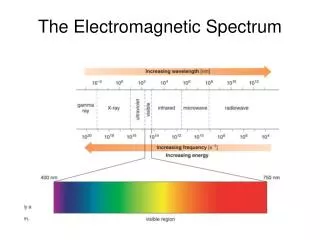
The Electromagnetic Spectrum
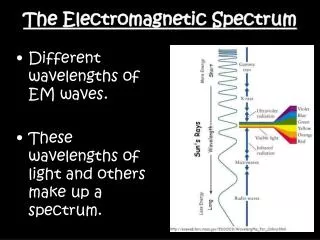
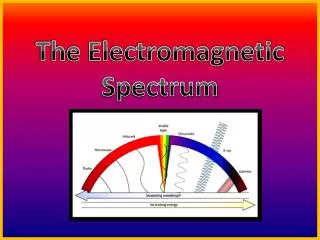
Explore how telescopes allow us to observe and measure light from distant stars, giving insight into their characteristics. Learn about star magnitude, including absolute magnitude (true brightness) and apparent magnitude (brightness as seen from Earth). Discover how the Doppler effect helps scientists analyze star movement through spectral shifts: a red shift indicates a star moving away, while a blue shift suggests it's approaching. Our understanding of gas spectra, such as neon and hydrogen, enhances our ability to understand these celestial bodies.

The Electromagnetic Spectrum
E N D
Presentation Transcript
The Electromagnetic Spectrum
Stars: How do we know? • use telescopes to observe and measure light from stars • magnitude = brightness of a star • absolute magnitude = actual brightness at a given distance • apparent magnitude = brightness as seen from Earth • Doppler shift • analyze star spectrum • if shifted towards red, star moving away from Earth • if shifted towards blue, star moving towards Earth
Doppler Shift NRAO/AUI/NSF 3
Gas Spectra Neon Sodium 656 nm 434 nm 486 nm Hydrogen NRAO/AUI/NSF 4