FDA Criticizes Merck's Misleading Claims on Vioxx Cardiovascular Safety
110 likes | 216 Vues
In a series of exchanges from 2001, the FDA reprimanded Merck for their misleading claims regarding Vioxx's cardiovascular safety profile. The FDA indicated that Merck's assurances of a favorable safety profile were supported only by hypothetical arguments, lacking substantial evidence. Notably, Merck's press releases conflicted with findings from their own studies, revealing a significantly higher rate of cardiovascular events in Vioxx users compared to alternatives like Naproxen. Internal communications at Merck revealed skepticism about their claims, raising further concerns about their interpretation of clinical data.


FDA Criticizes Merck's Misleading Claims on Vioxx Cardiovascular Safety
E N D
Presentation Transcript
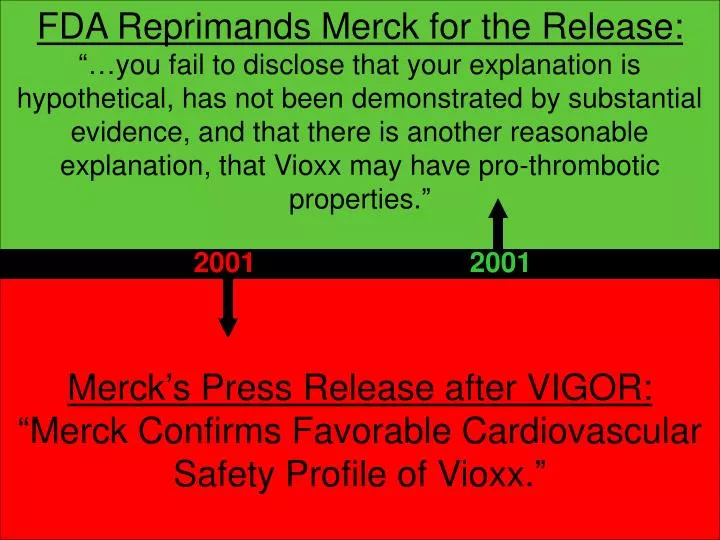
FDA Reprimands Merck for the Release: “…you fail to disclose that your explanation is hypothetical, has not been demonstrated by substantial evidence, and that there is another reasonable explanation, that Vioxx may have pro-thrombotic properties.” 2001 2001 Merck’s Press Release after VIGOR: “Merck Confirms Favorable Cardiovascular Safety Profile of Vioxx.”
FDA says: “…your claim in the press release that Vioxx has a ‘favorable cardiovascular profile,’ is simply incomprehensible…” 2001 2001 Merck’s Press Release after VIGOR: “Merck Confirms Favorable Cardiovascular Safety Profile of Vioxx.”
What Merck Knew: The rate of cardiovascular experiences in VIGOR was 14.6% in the VIOXX group 2000 2001 What Merck said in a letter to doctors: “the rate of cardiovascular events was 0.5 among patients taking VIOXX.”
What the FDA said to Merck: “Your claim… is again inaccurate.” 2000 2001 Merck told doctors at an audioconference: “Now if you look at the remaining part of VIGOR, which is 96 % of the VIGOR population, there’s no statistically significant difference in the MI [heart attack] rate between Naprosyn and Vioxx.”
Merck pooled data from multiple Vioxx trials and analyzed it for cardiovascular safety. 2000
Merck planned to publish their pooled analysis (meta-analysis), and they prepared a manuscript for internal review. 2001
Briggs Morrison told his Merck coworkers their analysis “seems wishful thinking, not a critical interpretation of the data.” June 2001 Oct. 2001 What Merck published in Circulation: “Conclusions—This analysis provides no evidence for an excess of CV events for rofecoxib”
Briggs Morrison said: “ ‘conclusions’ may be too strong a word; ‘there is no evidence’ also seems (to me) to be a bit of a stretch.” June 2001 Oct. 2001 Merck published: “Conclusions—This analysis provides no evidence for an excess of CV events for rofecoxib”
Briggs Morrison said: “the data appears to have been interpreted to support a preconceived hypothesis rather than critically reviewing the data to generate hypotheses.” June 2001 Oct. 2001 Merck published: “Conclusions—This analysis provides no evidence for an excess of CV events for rofecoxib”
What Merck Knew about ADVANTAGE: VIOXX – 8 Heart Attacks/Cardiac Death Naproxen – 1 Heart Attack Statistically Significant - YES 2001 2003 Merck published: “The rofecoxib and naproxen groups did not differ significantly in the number of thrombotic cardiovascular events…”
What Merck Knew about ADVANTAGE: VIOXX – 8 Heart Attacks/Cardiac Death Naproxen – 1 Heart Attack Statistically Significant - YES 2001 2003 Merck published: VIOXX – 5 Heart Attacks/Cardiac Death Naproxen – 1 Heart Attack Statistically Significant - NO