Primes, Composites, and Divisibility
This guide explores the concepts of prime numbers, composite numbers, and divisibility. A number is divisible by another if the quotient is a whole number. We provide rules for checking divisibility by 2, 3, 4, 5, 6, and 9, with examples to illustrate each rule. It also explains the differences between prime numbers, which have only two factors (1 and itself), and composite numbers, which have more than two factors. Learn how to determine whether specific numbers are prime or composite through practical examples.


Primes, Composites, and Divisibility
E N D
Presentation Transcript
What does divisible mean? A number is divisible by another number if the quotient and divisor are whole numbers. 42 6 = 7 quotient divisor dividend
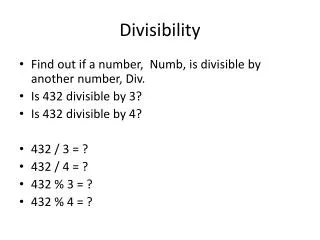
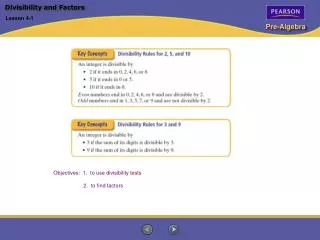
When is a number divisible by… 2? 3? 4? A number is divisible by … 2 if the last digit is even (0, 2, 4, 6, 8) 3 if the sum of the digits is divisible by 3 (45 is divisible by 3 because 4 + 5 is divisible by 3) 4 if the last two digits are divisible by 4; also even (412: 12 is divisible by 4)
When is a number divisible by… 5? 6? 9? A number is divisible by … 5 if the last digit is 0 or 5 (15, 70, 225) 6 if the number is divisible by both 2 and 3 9 if the sum of the digits is divisible by 9 (972: 9+7+2 is divisible by 9)
Example 1:Tell whether 610 is divisible by 2, 3, 4, and 5. 610 • Yesthe last digit is even • No6+1+0=7 not divisible by 3 • No10 is not divisible by 4 • Yesthe last digit is 5
Example 2:Tell whether 387 is divisible by 6, 9, and 10. 387 6 Nosince 387 is not even it is not divisible by 2 9 Yes3+8+7=18, which is divisible by 9 10 Noit does not end in a 0
What is a composite number? A composite number is any number greater than 1 that has more than two factors
What is a prime number? A prime number has only two factors: 1 and itself.
Example 3:Tell whether each is prime or composite • 45 composite 1 x 45, 3 x 15, 5 x 9 (B) 13 prime 1 x 13 (C) 19 prime 1 x 19 (D) 49 composite 1 x 49, 7 x 7