Reaction Rates and Equilibrium
This overview covers essential concepts in chemical kinetics and equilibrium, including reaction rates determined by the change in the amount of reactants over time. It introduces Collision Theory, which states that particles must collide with sufficient kinetic energy to form products. Key factors influencing reaction rates include temperature, concentration, particle size, and catalysts. The discussion extends to reversible reactions and equilibrium, emphasizing dynamic balance where forward and reverse reaction rates are equal, yet concentrations may differ. Le Chatelier’s Principle is also highlighted for its role in systems under stress.

Reaction Rates and Equilibrium
E N D
Presentation Transcript
Rate and Collisions • Reaction rate = amount of reactant changing over time • Collision Theory—atoms, ions, or molecules can form new products when they collide with enough kinetic energy
Factors Affecting Rate • Temperature—usually, raising temp. speeds up a rxn. • Concentration—greater conc. speeds up a rxn. • 2HCl + Mg → MgCl2 + H2
Factors Affecting Rate • Particle size—increased surface area speeds up a rxn. • CH3CH2OH + 3O2→ 2CO2 + 3H2O • Catalysts—lowers activation energy with its presence • 3CuSO4 + 2Al → Al2(SO4)3 + 3Cu
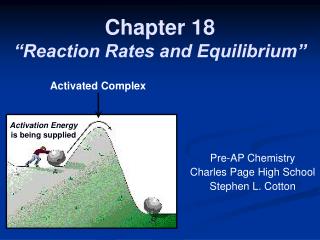
Activation energy • Activation energy—minimum amt. of energy particles must have in order to react. • This is a “hump” that the reactants need to get over in order to form new compounds. • At the peak of the hump, the particles form an “activated complex” or “transition state” that lasts for an instant.
Reversible Rxns. • Some rxns can proceed in either direction: • 2SO2(g) + O2(g)→ 2SO3(g) Or • 2SO3(g) → 2SO2(g) + O2(g)
Equilibrium • When the rate of the forward rxn and the rate of the reverse rxn are the same, the rxn has reached chemical equilibrium. • This DOES NOT mean that the concentration of products and reactants is the same. • At equilibrium, no change in the amount of rxn components occurs.
2C2H6(g) + 7O2(g)→ 4CO2(g) + 6H2O(g) • Keq = • If Keq = 0.13, does equilibrium lie to the right or the left? • If Keq = 3.58, does equilibrium lie to the right or the left? • Why would the value of Keqchange?
LeChatelier’s Principle • If a stress is applied to an equilibrium system, the system will respond to relieve the stress.
Upsetting Equilibrium • Concentration—system will adjust to minimize the effect of added reactant/product. • If a reactant/product is removed, system will respond to fill that void. 2CrO4 + 2H3O+↔ Cr2O7 + 3H2O
Upsetting Equilibrium • Temperature—increasing temp. causes system to shift in the direction that absorbs heat. Cooling the system pushes it in the direction of producing heat. • 2SO2(g) + O2(g)→ 2SO3 + heat
Upsetting Equilibrium • Pressure—this only affects gases. With additional pressure, the rxn shifts to the side with fewer particles. • N2(g) + 3H2(g)→ 2NH3(g)