
Meat Science and Slaughter Process: A Comprehensive Guide
E N D
Presentation Transcript
Slaughter Process • Immobilization • Animal is rendered unconscious • does not feel pain
Kosher Slaughter • animal is slaughtered under the regulations of the Jewish religion • animals slaughtered for Kosher markets do not have to be stunned.
Methods • Carbon dioxide chamber • electric shock • cartridge or mechanical bolt
Immobilization • allows the heart to pump in order to drain the animal’s body of blood
Exsanguination • process of bleeding the animal • usually done by severing the jugular vein with a sharp knife
Exsanguination • bleeding must be done quickly to avoid hemorrhaging • hemorrhaging can cause blood spots in the meat
Hemorrhage • escape of blood from ruptured blood vessels • caused by a rise in blood pressure
Hide and organs removed • liver • brains • pancreas • intestines • heart and kidneys
In the US • there are over 5000 plants that slaughter animals
Hogs • are dipped into scalding water and placed on a machine that scrapes the hair from the hide • some plants may skin hogs
Organs used for food • liver - most common • brains, pancreas, intestines, and heart • kidneys may also be used for human consumption
Inspectors • are present to inspect carcass and internal organs • detect any health concerns
Inspectors • if a problem is found with the carcass, the entire carcass may be condemned • each carcass to be sold must be inspected
Cooling • carcasses may be wrapped in a shroud • carcass goes through rigor mortis • carcass may be aged
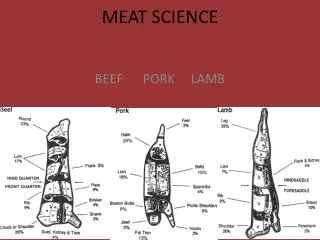
Cooling • beef carcasses are split down the middle • sides of beef are created by sawing down the backbone
Carcasses • may be divided into quarters by cutting each side in two pieces. • Sides are divided at the 12th and 13th rib to form quarters
Carcasses • lamb carcasses are usually sent to the cooler whole as they are much smaller • hog carcasses are split into sides by cutting down the backbone.
Carcasses • beef and hog carcasses that have been skinned are covered in a heavy cloth soaked in salt water • called a shroud
Shroud • prevents the carcass from drying out
Carcasses • are cooled down rapidly • go through rigor mortis • muscles lock into place and carcass becomes stiff
Rigor Mortis • physiology is similar to muscle contractions in live animals • carcass muscles do not relax
Rigor Mortis • onset usually takes 6 - 12 hours for beef and lamb • 30 minutes - 3 hours for pork
Rigor Mortis • as enzymes and microorganisms begin to break down the muscle tissue, rigor mortis is partially relaxed
Cooling • Quick cooling of meat is important to minimize protein degradation • inhibit growth of microorganisms
Pork and Lamb • carcasses are usually cooled for 18-24 hours before cutting
Beef • cooled for 30 or more hours before cutting into wholesale cuts • may also be aged in the cooler for as much as a week
Aging • carcasses undergo a period of aging to allow enzymes and microoganims to begin the process of breaking down the tissue
Aging • improves tenderness and flavor • adds to the expense of processing meat
Aging alternatives • electric stimulation of muscles • current of 600 volts is sent through the carcass right after slaughter and before the hide is removed
Aging alternatives • stimulation speeds natural processes that occur after death • depletion of energy stores from the body
Electric stimulation • improves tenderness • improve color, texture and firmness • makes hide removal easier
Grading • carcasses are graded according to USDA standards • federal meat grading was established in 1925
Grading • administered by the AMS (Agricultural Marketing Service) of the USDA
Grade • certifies class, quality and condition with uniform standards
Quality grades • prediction of the eating quality (palatability) of the meat when properly prepared
Yield Grades • indicate expected yield of edible meat from a carcass and the subsequent wholesale cuts from that carcass
Grading • is voluntary and is paid for by the packer
Quality Beef Grades • prime • choice • select • standard • commercial
Quality Beef Grades • utility • cutter • canner
Grades • are determined by the age of the animal • amount of fat intermingled with the muscle
Age • determined by maturity of the cartilage and bones • cartilage hardens and turns to bone as the animal ages
Age • graders inspect the rib cage and vertebrae for the degree of bone and cartilage hardening - ossification
Age • as the animal ages, vertebrae in the lower end of backbone tend to fuse or grow together. • Animals older than about 42 months cannot receive the highest two grades
Age • younger animals are usually more tender than older animals
Fat • fat, known as marbling • shows up as specks of white across the rib eye • more specks of fat that are visible, the higher the grade
Prime • has the highest degree of fat in the muscle • fat gives meat its flavor and juiciness
Prime • fat is expensive to put on animals • leaner grades are less expensive
Feedlot operators • want their animals to grade low choice at slaughter • those raising prime animals usually cater to the restaurant trade
Beef • most beef bought in the grocery store is choice grade. • A few market chains are selling the leaner select grade as a low fat meat