Download
1 / 18
180 likes | 311 Vues
The NSLS-II project aims to create a robust suite of beamlines accommodating over 1300 users, supported by state-of-the-art insertion devices. Featuring multiple straight sections, our design enables significant versatility, including potential for 57 beamlines with advanced capabilities in physical and life sciences. Key beamlines cover areas such as inelastic x-ray scattering, nanoprobe techniques, and soft and hard x-ray coherent scattering. This development will foster comprehensive research opportunities, harnessing unique capabilities of the NSLS-II source while providing critical user infrastructure. ###

E N D
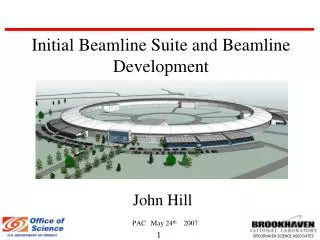
John HillPACMay 24th 2007 Initial Beamline Suite and Beamline Development
NSLS-II Beamlines 15 five m straights for user undulators Could potentially drive up to 30 beamlines by canting two undulators 4 eight m straights for user undulators Could potentially drive up to 8 beamlines by canting two undulators 8 eight m straights for user damping wigglers Could potentially drive up to 16 beamlines by canting two DWs 27 BM ports for UV, soft X-rays and hard-xray (3PWs) 3 BM ports for far-IR At least 57 beamlines More w/ multiple IDs per straight Multiple hutches per beamline are also possible
Possible Insertion Device Usage at NSLS-II • Physical Science Beamlines • 6 project beamlines in red • 16 MIE beamlines in blue • Estimate that these 22 beamlines could accommodate ~ 1300 users • Life Science Beamlines • 5 other funded beamlines • Three straights left unassigned
Possible Bending Magnet Usage at NSLS-II “Beamline types” in red are beamlines to be moved over from NSLS Note: there is not always a 1:1 correspondence with beamlines at NSLS and NSLS-II. In some cases, equipment may be taken from multiple beamlines.
NSLS-II Strawman Capabilities Possible distribution among beamline categories (and compared to existing NSLS) N.B. NSLS-II distribution includes some canting (principally, damping wigglers) and also leaves 3 straights unassigned.
Project Beamlines Project goal: To provide a minimum suite of insertion device beamlines to meet physical science that both exploit the unique capabilities of the NSLS-II source and provide work horse instruments for large user capacity. The beamlines are: Inelastic x-ray scattering (0.1 meV) Nanoprobe (1nm) Soft x-ray coherent scattering and imaging Hard x-ray coherent scattering and SAXS Powder diffraction (damping wiggler source) EXAFS (damping wiggler source) Total = $65.2 M (direct, FY06 dollars) EFAC Approved these choices: May 10th, 2007
Early Phase Beamlines at Other Sources NSLS-II 1) Inelastic 2) Nanoprobe 3) Soft Coherent 4) Hard Coherent 5) EXAFS 6) Powder 7-9) PX 10-13) EXAFS/NEXAFS 14) SAXS 15) Powder 16-17) IR 18-23) Imaging 24) ARPES 25) Scattering 26) MCD ASP 1) IR 2) PX (BM) 3) Soft (undulator) 4) EXAFS (wiggler) 5) Powder (BM) CLS 1) far-IR 2) UV (PEEM+XAS) 3) Soft (STXM) 4) Soft (PEEM+XAS) 5) EXAFS Diamond 1) PX 2) PX 3) PX 4) Soft - PEEM 5) EXAFS 6) high-E: Powder +single Xtal 7) Scattering (Mat. Sci)
Inelastic X-ray Scattering • Mission • Low energy modes in soft matter • Phonons in small samples (Hi-P, single crystal..) • Capabilities • 0.1 meV, fixed energy • 1.0 meV, fixed energy • Cost • $10.5 M (FY06, Direct) • Source • U19 in short straight* • *A candidate for extended straight. 0.1 meV 1.0 meV
Nanoprobe • Mission • Nanoscience: hard-matter • Imaging, diffraction • Capabilities • 1nm, short working distance • 10nm, larger working distance • Possible remote hutch • Cost • $13.8 M (FY06, Direct) • Source • U19 in short straight* • *A candidate for extended straight. 1 nm 10 nm
Soft X-ray Coherent Scattering • Mission • Imaging of bio samples • Hard matter, magnetic systems • Capabilities • Coherent imaging + microspectroscopy • Coherent scattering • Fast switching of polarization • Cost • $10.5 M (FY06, Direct) • Source • 2 x EPU 45 in short straight (canted at 0.25 mrad)
Hard X-ray Coherent Scattering • Mission • Slow dynamics in soft matter • Nanoscale imaging of hard matter • time-resolved SAXS (biological processes) • Capabilities • XPCS/SAXS • Coherent Diffraction • Cost • $16.4 M (FY06, Direct) • Source • U19 in long straight* • *gap > 7mm Coherent Diffraction/SAXS XPCS Secondary optics
Powder Diffraction • Mission • Materials Science • time-resolved catalysis • Capabilities • 5-50 keV • Analyser-mode and strip-detector mode • Sample environments (high-P, low-T, high-T..) • Cost • $7 M (FY06, Direct) • Source • 3m damping wiggler in long straight BM hutch Powder-I Powder-II
EXAFS Mission Environmental science, catalysis Materials science Capabilities microprobe Cost $7 M (FY06, Direct) Source 3m damping wiggler in long straight BM hutch EXAFS-I EXAFS-II
Beamline Development “Develop policy whereby the design, construction, and operation of all beamlines, Beamline Access Team (DOE funded) and Beamline Development Team (non-DOE funded) beamlines, will be the responsibility of Experimental Facilities staff.” DOE Guidance
Beamline Access All beamlines will have at least 50% GU time Partner User Proposals can be up to 30%. (User groups partnering with the facility) Staff time up to 20% Steady State operations Note, this is also true for Externally Funded Beamlines • Includes non-BES DOE, NIH, NSF, State… • Funds to flow through facility • Facility will design, build and operate the beamline • External group can operate as PU, but most likely mode of operation is to support a full GU program.
Beamline Advisory Teams (BATs) • Facility has ultimate responsibility for design, construction and operation for all beamlines. • BATs will : • Propose scientific mission and technical capabilitesof beamline (reviewed by EFAC, chosen by facility). • Work closely with the facility to advise them during design, construction and early operations. • Take part in periodic design reviews. • Represent a particular User community. • Report to XFD Director Considering the formation of a Beamline Council, made up of BAT Chairs, to advise facility. Meets regularly (~ twice a year?).
BATs (BES-funded beamlines) • Applies to: • All BES funded beamlines (insertion devices, 3-pole wigglers and dipoles) • Small teams chosen based on recommendation of EFAC, to advise on mission, design and construction of a beamline. • Facility hires beamline scientists, for whom BAT acts as advisory body. • BAT meets every 6 months with beamline scientist (reports to XFD Division Director and .cc-ed to EFAC ). • BAT members do not get preferential access to beamtime. • May continue to advise facility during operations.
BATs (non-BES funded beamlines) • Applies to: • non-BES DOE, NIH, NSF, State funded, industrial… • BAT members appointed by fundraisers (e.g. PIs on grant, principals in industry, etc). • Negotiated on a case-by-case basis. Most expected to run peer-reviewed user programs in 80:20 type mode. Staff may be facility employees or employees of external group. • Does not automatically expire if operational funds continue to flow. • Reviewed by EFAC every 3 years. High threshold on staffing, technical quality and scientific productivity metrics.