Exploring Planetary Sizes and Characteristics of Stars
In this week's lessons, we will explore planets and stars, focusing on their sizes and characteristics. Students will learn which planet is almost identical in size to Earth—it's Venus! Additionally, we will delve into the classification of stars based on their size, color, and brightness, including supergiants, giants, and neutron stars. Key topics also include absolute and apparent magnitude, and the relationship between a star's brightness and surface temperature, illustrated by the findings of astronomers Henry Russell and Ejnar Hertzsprung. Don't miss our upcoming quiz and project due date!

Exploring Planetary Sizes and Characteristics of Stars
E N D
Presentation Transcript
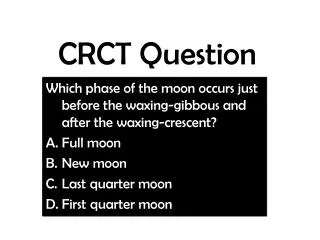
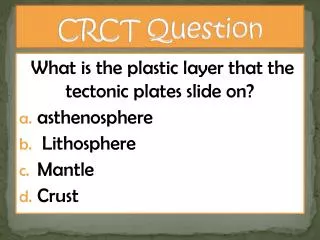
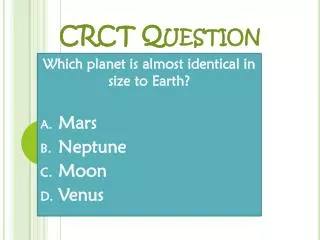
CRCT Question Which planet is almost identical in size to Earth? Mars Neptune Moon Venus
Week at a Glance Monday: Sun Notes #1 Tuesday: Sun Notes #2 Wednesday: Workday Thursday: Telescope Notes Friday: Workday Next Week: Wednesday: QUIZ Thursday: Project DUE
Big Bang Video
v. Characteristics of Stars
a. Classifying Stars 1. size of the star – supergiant, giant, medium, white dwarfs, neutron stars. 2. color - surface temperature - Coolest are red, then orange, yellow (our Sun), blue, white 3. brightness – magnitude a. apparent magnitude– close stars look brighter b. absolutemagnitude– actual light
Supergiant Giant Medium sized White dwarf Neutron star 1. Star sizes
Comparison of our sun with a white dwarf and a neutron star.
Star color 2. Determined by surface temperature. • Hottest are blue • Coolest are red.
Color Of Stars Video
3. Absolute vs. apparent magnitude i. Absolute magnitude is how much light is actually given off by a star. ii. Apparent magnitude is how bright a star appears to be due to how close or far away it is.
Two astronomers discovered a relationship between the absolute magnitude (real brightness) of a star and its surface temperature. They plotted the data on a graph. Henry Russell USA EjnarHertzsprung Denmark
So what does this show? Stars seemed to naturally group together
4. Grouping Stars They discovered that stars grouped by type and during their lifetimes would move from one place on the graph to another. As our sun ages, it will move to a giant star to a white dwarf.