Download
1 / 63
630 likes | 736 Vues
Prepare for your O&P Board exam with this comprehensive review game focusing on muscle actions, bone landmarks, joint articulations, and nerves. Packed with hundreds of questions across various difficulty levels, this interactive study tool helps you solidify your understanding of essential biomechanics and anatomy. From the main supinator of the forearm to the importance of the periosteum, challenge yourself and enhance your knowledge in a fun and engaging way. Perfect for students and professionals alike!

E N D
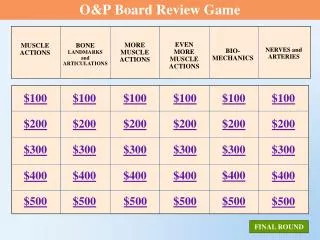
O&P Board Review Game EVEN MORE MUSCLE ACTIONS MORE MUSCLE ACTIONS MUSCLE ACTIONS BONE LANDMARKS and ARTICULATIONS NERVES and ARTERIES BIO-MECHANICS $100 $100 $100 $100 $100 $100 $200 $200 $200 $200 $200 $200 $300 $300 $300 $300 $300 $300 $400 $400 $400 $400 $400 $400 $500 $500 $500 $500 $500 $500 FINAL ROUND
MUSCLE ACTIONS100 Question • The main supinator of the forearm is the • a. Flexor carpi radialis • b. Pronator quadrates • c. Extensor carpi radialis • d. Biceps brachii ANSWER
MUSCLE ACTIONS $100 Answer • The main supinator of the forearm is the • a. Flexor carpi radialis • b. Pronator quadrates • c. Extensor carpi radialis • d. Biceps brachii
MUSCLE ACTIONS $200 Question • The main flexor of the hip joint is the: • a) Rectus femoris • b) Tensor fascia latae • c) Sartorius • d) Iliopsoas ANSWER
MUSCLE ACTIONS $200 Answer • The main flexor of the hip joint is the: • a) Rectus femoris • b) Tensor fascia latae • c) Sartorius • d) Iliopsoas
MUSCLE ACTIONS $300 Question • Inversion of the foot is accomplished primarily by the • a. Peroneal muscles • b. FDL • c. Tibialis anterior and posterior • d. Gastroc-soleus complex ANSWER
MUSCLE ACTIONS $300 Answer • Inversion of the foot is accomplished primarily by the • a. Peroneal muscles • b. FDL • c. Tibialis anterior and posterior • d. Gastroc-soleus complex
MUSCLE ACTIONS $400 Question • The biceps brachii muscle creates what motion? • a. Elbow extension • b. Glenohumeral extension • c. Forearm pronation • d. Elbow flexion ANSWER
MUSCLE ACTIONS $400 Answer • The biceps brachii muscle creates what motion? • a. Elbow extension • b. Glenohumeral extension • c. Forearm pronation • d. Elbow flexion
MUSCLE ACTIONS $500 Question • Elevation of the scapula is accomplished by which muscle? • a. Trapezius • b. Pectoralis minor • c. Supraspinatus • d. Latissimus dorsi ANSWER
MUSCLE ACTIONS $500 Answer • Elevation of the scapula is accomplished by which muscle? • a. Trapezius • b. Pectoralis minor • c. Supraspinatus • d. Latissimus dorsi
BONE LANDMARKS AND ARTICULATIONS$100 Question • The most prominent and highest point of the shoulder girdle is the? • a. Acromium • b. Coracoid process • c. Spine of the scapula • d. Superior angle of the scapula ANSWER
BONE LANDMARKS AND ARTICULATIONS$100 Answer • The most prominent and highest point of the shoulder girdle is the? • a. Acromium • b. Coracoid process • c. Spine of the scapula • d. Superior angle of the scapula
BONE LANDMARKS AND ARTICULATIONS$200 Question • All of the following bones form the acetabulum except: • a. Ilium • b. Sacrum • c. Pubis • d. Ischium ANSWER
BONE LANDMARKS AND ARTICULATIONS$200 Answer • All of the following bones form the acetabulum except: • a. Ilium • b. Sacrum • c. Pubis • d. Ischium
BONE LANDMARKS AND ARTICULATIONS$300 Question • The talus does not articulate with the: • a. Tibia • b. Cuboid • c. Navicular • d. Fibula ANSWER
BONE LANDMARKS AND ARTICULATIONS$300 Answer • The talus does not articulate with the: • a. Tibia • b. Cuboid • c. Navicular • d. Fibula
BONE LANDMARKS AND ARTICULATIONS$400 Question • Which bone is most likely to have boney overgrowth? • a. Humerus • b. Femur • c. Tibia • d. Radius ANSWER
BONE LANDMARKS AND ARTICULATIONS$400 Answer • Which bone is most likely to have boney overgrowth? • a. Humerus • b. Femur • c. Tibia • d. Radius
BONE LANDMARKS AND ARTICULATIONS$500 Question • What is the reason that it is important not to disrupt the periosteum? ANSWER
BONE LANDMARKS AND ARTICULATIONS$500 Answer • What is the reason that it is important not to disrupt the periosteum? • To prevent bone overgrowth
MORE MUSCLE ACTIONS$100 Question • The biceps brachii produces which of the following actions of the elbow and forearm: • a. Extension, pronation • b. Extension, supination • c. Flexion, pronation • d. Flexion, supination ANSWER
MORE MUSCLE ACTIONS $100 Answer • The biceps brachii produces which of the following actions of the elbow and forearm: • a. Extension, pronation • b. Extension, supination • c. Flexion, pronation • d. Flexion, supination
MORE MUSCLE ACTIONS $200 Question • During normal human locomotion, the primary function of the gluteus medius is to: • a. Control the degree of femoral adduction • b. Stabilize the knee • c. Maintain lateral stability of the pelvis • d. Flex the hip joint ANSWER
MORE MUSCLE ACTIONS $200 Answer • During normal human locomotion, the primary function of the gluteus medius is to: • a. Control the degree of femoral adduction • b. Stabilize the knee • c. Maintain lateral stability of the pelvis • d. Flex the hip joint
MORE MUSCLE ACTIONS $300 Question • What is the action of supraspinatus? • A. Adduction of the arm • B. Abduction of the arm • C. Protraction of the scapula • D. Retraction of the scapula ANSWER
MORE MUSCLE ACTIONS $300 Answer • What is the action of supraspinatus? • A. Adduction of the arm • B. Abduction of the arm • C. Protraction of the scapula • D. Retraction of the scapula
MORE MUSCLE ACTIONS $400 Question • What is the action of the peroneus longus? • a. Eversion, dorsiflexion • b. Eversion, plantarflexion • c. Inversion, dorsiflexion • d. Inversion, plantarflexion ANSWER
MORE MUSCLE ACTIONS $400 Answer • What is the action of the peroneus longus? • a. Eversion, dorsiflexion • b. Eversion, plantarflexion • c. Inversion, dorsiflexion • d. Inversion, plantarflexion
MORE MUSCLE ACTIONS $500 Question • Serratus anterior performs which action? • A. Protraction, stabilization, downward rotation • B. Protraction, stabilization, upward rotation • C. Retraction, stabilization, downward rotation • D. Retraction, stabilization, upward rotation ANSWER
MORE MUSCLE ACTIONS $500 Answer • Serratus anterior performs which action? • A. Protraction, stabilization, downward rotation • B. Protraction, stabilization, upward rotation • C. Retraction, stabilization, downward rotation • D. Retraction, stabilization, upward rotation
EVEN MORE MUSCLE ACTIONS $100 Question • Brachioradialis performs which function? • A. Extension of elbow • B. Flexion of elbow only • C. Flexion of elbow and some pronation and supination • D. Pronation only • E. Supination only ANSWER
EVEN MORE MUSCLE ACTIONS $100 Answer • Brachioradialis performs which function? • A. Extension of elbow • B. Flexion of elbow only • C. Flexion of elbow and some pronation and supination • D. Pronation only • E. Supination only
EVEN MORE MUSCLE ACTIONS $200 Question • Which muscle passes anterior to the lateral malleolus? • a. Peroneus longus • b. Peroneus brevis • c. Peroneus tertius • d. Posterior tibialis ANSWER
EVEN MORE MUSCLE ACTIONS $200 Answer • Which muscle passes anterior to the lateral malleolus? • a. Peroneus longus • b. Peroneus brevis • c. Peroneus tertius • d. Posterior tibialis
EVEN MORE MUSCLE ACTIONS $300 Question • Which muscle best compensates for a weak anterior tibialis muscle? • a. tibialis posterior • b. flexor digitorum longus • c. flexor hallucis longus ANSWER
EVEN MORE MUSCLE ACTIONS $300 Answer • Which muscle best compensates for a weak anterior tibialis muscle? • a. tibialis posterior • b. flexor digitorum longus • c. flexor hallucis longus
EVEN MORE MUSCLE ACTIONS $400 Question • Which of the following muscles does NOT cause hip adduction • a. Adductor longus, brevis, and magnus • b. pectineus • c. gracilis • d. sartorius ANSWER
EVEN MORE MUSCLE ACTIONS $400 Answer • Which of the following muscles does NOT cause hip adduction • a. Adductor longus, brevis, and magnus • b. pectineus • c. gracilis • d. sartorius
EVEN MORE MUSCLE ACTIONS $500 Question • If a patient’s shoulder dislocates anteriorly, which movement does NOT need to be limited? • A. Scapular retraction • B. Scapular protraction • C. Internal rotation of the humerus • D. Extension of the humerus ANSWER
EVEN MORE MUSCLE ACTIONS $500 Answer • If a patient’s shoulder dislocates anteriorly, which movement does NOT need to be limited? • A. Scapular retraction • B. Scapular protraction • C. Internal rotation of the humerus • D. Extension of the humerus
BIOMECHANICS $100 Question • Which of the following muscles undergoes contraction between heel strike and foot flat? • a. Tibialis posterior • b. Tibialis anterior • c. Peroneus longus • d. Gastrocnemeus ANSWER
BIOMECHANICS $100 Answer • Which of the following muscles undergoes contraction between heel strike and foot flat? • a. Tibialis posterior • b. Tibialis anterior • c. Peroneus longus • d. Gastrocnemeus
BIOMECHANICS $200 Question • To minimize lateral trunk bending subsequent to hip abductor weakness, it is best to use a cane on: • a. The involved side • b. The uninvolved side • c. Both sides ANSWER
BIOMECHANICS $200 Answer • To minimize lateral trunk bending subsequent to hip abductor weakness, it is best to use a cane on: • a. The involved side • b. The uninvolved side • c. Both sides
BIOMECHANICS $300 Question • During normal heel strike, the forward hip is • A. Flexed 25 degrees • B. Flexed 40 degrees • C. Neutral • D. Extended 10 degrees ANSWER
BIOMECHANICS $300 Answer • During normal heel strike, the forward hip is • A. Flexed 25 degrees • B. Flexed 40 degrees • C. Neutral • D. Extended 10 degrees
BIOMECHANICS $400 Question • The body’s center of gravity reaches its highest point at • A. Heel strike • B. Foot flat • C. Midstance • D. Heel off ANSWER
BIOMECHANICS $400 Answer • The body’s center of gravity reaches its highest point at • A. Heel strike • B. Foot flat • C. Midstance • D. Heel off
BIOMECHANICS $500 Question • The center of gravity of the adult male is located on the midline of the body at approximately the level of the: • A. Greater trochanter of the femur • B. Pubic symphysis • C. Acetabulum • D. Anatomical neck of the femur • E. S-2 ANSWER