Effective Time Management for Adult Learners: Unlocking Your Potential
This session aims to help adult learners identify their long-term goals and develop effective prioritization skills. With the many competing demands from work and family, participants will learn how to manage time efficiently to achieve their academic goals. The workshop will focus on creating a productive study timetable, using short bursts of study time, and recognizing procrastination. Techniques such as the Pareto Principle and utilizing a ‘to-do list’ will be discussed to enhance productivity and establish a fulfilling study routine.

Effective Time Management for Adult Learners: Unlocking Your Potential
E N D
Presentation Transcript
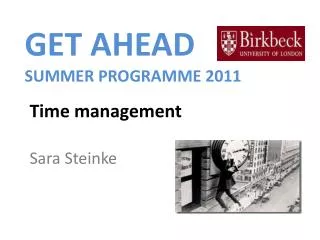
GET AHEAD SUMMER PROGRAMME 2011 Time management Sara Steinke
Aims of the session • To explore your long-term goals • To consider how to prioritise your tasks • To establish a study timetable
Why consider time management? • adult learners have many, often competing/conflicting, demands on their time, particularly involving family and work • in most cases, it is not ability that prevents students from achieving their best, but poor time management • related to other study skills required at university – study space, essay writing process, presentations, exams, reading for learning
Think about the following • What current pressures are there on your time? • Have you thought about how you are going to fit in studying? If so, what ideas have you had? Don’t worry if not, this session is a good opportunity to start and will suggest some ideas.
Small pockets of time – around 45 minutes – are more productive. Short and frequent portions of time soon add up. Recognise and deal with procrastination; set short, medium and long term goals; identify your time wasters (self-inflicted and given) Pareto Principle – 20% of our efforts deliver 80% of our results; 20% effort delivers an acceptable result, not perfect, but good enough L’Oreal principal – ‘because you’re worth it’; educate your family, friends and colleagues to respect your study space/time Use one diary to create a ‘to-do list’; prioritise tasks; note deadlines; write down dates you must begin working towards the deadlines.
Establishing a study timetable Write down three time management aspects that you have learnt/thought about in this class. How are you going to use these ideas to plan – and stick to – a study timetable?
Recap • We started to identify how well you use your time and how you will fit in your study (known as a study skills audit) • We explored your short, medium and long term goals – S.M.A.R.T. • We thought about techniques for prioritising your tasks and establishing a study time table
Cottrell, S. (2008) The Study Skills Handbook, 3rd Edition (London, Palgrave) chapter 4 ‘The C.R.E.A.M. Strategy for learning’ pp.70-79 http://www.palgrave.com/ skills4study/studyskills/ learning/time.asp (relevant tips and activity related to the above book) http://www.bbk.ac.uk/ mybirkbeck/services/facilities /support/time-management (online resources available on the Birkbeck Library website) http://www.bbk.ac.uk/ mybirkbeck/get-ahead-stay- ahead/skills/organisational- skills (a 20 minute interactive tutorial supporting this Get Ahead Summer programme)