Understanding the Need for Naps: Boosting Performance and Safety in Everyday Life
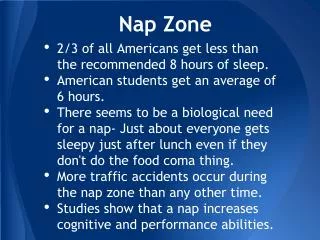
Many Americans struggle to get the recommended 8 hours of sleep, with students averaging just 6 hours. This shortfall often leads to a mid-afternoon sleepiness, known as the "nap zone," which correlates with increased traffic accidents. Research shows that taking a nap can enhance cognitive function and overall performance. Additionally, exploring the science of sleep and dreams, including the biological clock, circadian rhythms, and various theories on why we dream, reveals the intricate relationship between sleep, mental health, and daily performance.

Understanding the Need for Naps: Boosting Performance and Safety in Everyday Life
E N D
Presentation Transcript
Nap Zone 2/3 of all Americans get less than the recommended 8 hours of sleep. American students get an average of 6 hours. There seems to be a biological need for a nap- Just about everyone gets sleepy just after lunch even if they don't do the food coma thing. More traffic accidents occur during the nap zone than any other time. Studies show that a nap increases cognitive and performance abilities.
Dreams: Lucid dreams
Four explanations for why we dream: 1. Dreams as unconscious wishes. 2. Dreams as reflections of current concerns. 3. Dreams as by-product of mental housekeeping. 4. Dreams as interpreted brain activity.