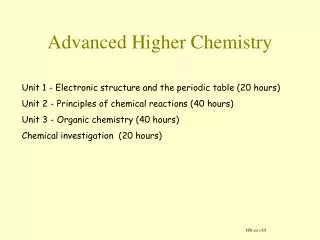
Advanced Higher Chemistry
Chemistry of the oxides, chlorides and hydrides. Looking at the second and third periods, their chemistry can be explained in terms of their structure and type of bonding:. Melting points Boiling points Electrical conductivities. We will look at each family of compounds in turn?. The oxides. For

Advanced Higher Chemistry
E N D
Presentation Transcript
1. Advanced Higher Chemistry
2. Chemistry of the oxides, chlorides and hydrides
3. Forming metal oxides
4. Metal oxides- properties SOURCE- itl.chem.ufl.edu/2051_s97/week_1/ionic.html SOURCE- itl.chem.ufl.edu/2051_s97/week_1/ionic.html
5. Metal oxides- water
6. Aluminium oxide- amphoteric
7. Forming non-metal oxides
8. Non-metal oxides- water
9. Carbon monoxide concentrations SOURCE- www.unl.edu/.../Carbon%20Monoxide-97.gif
http://earthobservatory.nasa.gov/Newsroom/NewImages/images.php3?img_id=16550SOURCE- www.unl.edu/.../Carbon%20Monoxide-97.gif
http://earthobservatory.nasa.gov/Newsroom/NewImages/images.php3?img_id=16550
10. Silicon dioxide
11. The oxides- pH summary
12. The chlorides
13. Ionic chlorides- water
14. Covalent chlorides- water
15. Aluminium chloride SOURCE- www.answers.com/topic/aluminium-chloride-1 SOURCE- www.answers.com/topic/aluminium-chloride-1
16. The chlorides- pH summary
17. Forming hydrides
18. Structures
19. Ionic hydrides- water SOURCE- www.millsian.com/hydrides.shtml SOURCE- www.millsian.com/hydrides.shtml
20. Ionic hydrides- Uses
21. Electrolysis of hydrides
22. Scholar work