Absolute Advantage and Comparative Advantage
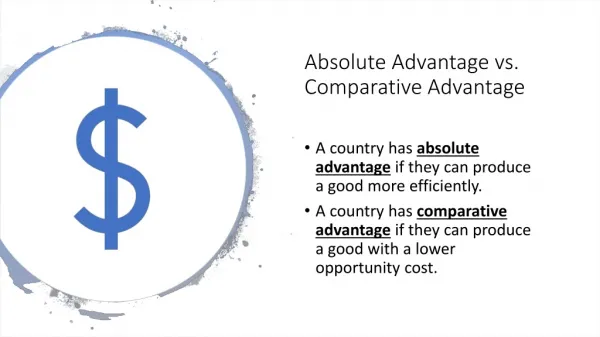
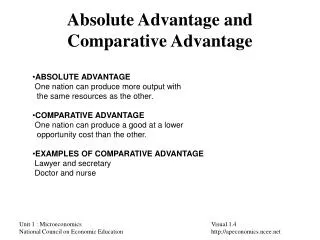
Absolute Advantage and Comparative Advantage. ABSOLUTE ADVANTAGE One nation can produce more output with the same resources as the other. COMPARATIVE ADVANTAGE One nation can produce a good at a lower opportunity cost than the other. EXAMPLES OF COMPARATIVE ADVANTAGE

Absolute Advantage and Comparative Advantage
E N D
Presentation Transcript
Absolute Advantage andComparative Advantage • ABSOLUTE ADVANTAGE • One nation can produce more output with • the same resources as the other. • COMPARATIVE ADVANTAGE • One nation can produce a good at a lower • opportunity cost than the other. • EXAMPLES OF COMPARATIVE ADVANTAGE • Lawyer and secretary • Doctor and nurse Unit 1 : Microeconomics Visual 1.4 National Council on Economic Education http://apeconomics.ncee.net
The Circular Flow of Resources,Goods, Services and Money Payments Unit 1 : Microeconomics Visual 1.3 National Council on Economic Education http://apeconomics.ncee.net
Possibilities CurveProduction Unit 1 : Microeconomics Visual 1.2 National Council on Economic Education http://apeconomics.ncee.net
The Economic Way of Thinking • Everything has a cost. • People choose for good reasons. • Incentives matter. • People create economic systems to • influence choices and incentives. • People gain from voluntary trade. • Economic thinking is marginal thinking. • The value of a good or service is affected by • people’s choices. • Economic actions create secondary effects. • The test of a theory is its ability to predict • correctly. Unit 1 : Microeconomics Visual 1.1 National Council on Economic Education http://apeconomics.ncee.net
Determining ComparativeAdvantage (Output Method) • 1. Which nation has an absolute advantage in producing CDs? • 2. Which nation has an absolute advantage in producing beef? • 3. Which nation has a comparative advantage in producing CDs? • 4. Which nation has a comparative advantage in producing beef? • 5. Should Japan specialize in CDs or beef? • 6. Should Canada specialize in CDs or beef? Unit 1 : Microeconomics Visual 1.5 National Council on Economic Education http://apeconomics.ncee.net
Changes in Demand and Quantity Demanded Unit 1 : Microeconomics Visual 2.1 National Council on Economic Education http://apeconomics.ncee.net