Comprehensive Guide to Moles, Molar Mass, and Mole Calculations in Chemistry
290 likes | 438 Vues
This resource serves as an essential guide for understanding key chemistry concepts related to the mole. It covers definitions of the mole, atomic structure, and various calculations such as molar mass and volume, while providing practical examples to solidify learning. Explore how to quantify particles, ions, and compounds using the mole, and practice determining the number of moles in given samples. Ideal for students preparing for the Chemistry EOC exam, this review emphasizes critical methods for solving mass-mole-particle problems effectively.


Comprehensive Guide to Moles, Molar Mass, and Mole Calculations in Chemistry
E N D
Presentation Transcript
The Mole a Review CFISD Chemistry EOC Prep
Terms to describe more than one of something… 1 Dozen = 12 of something
More terms to describe more than one of something… 1 Stone= 14 pounds (140 lbs =10 stones) 1 ream = 500 sheets of paper 1 cubic yard (y3) = 27 ft3 of stuff 1 yard
Science prefixes to describe more than one of something… • 1 Liter = 1000 mL • 1 gram = 1000 mg • 1 m = 100 cm Liters grams moles meters seconds
In chemistry, the most important term used to describe more than one of something and/or how much matter we have is the….. Mole
What’s a Mole? 1 mole = 6.02 X 10 23 particles Formula Units Ions Atoms Molecules 6.02 x 10²³ particles
What is an atom? Smallest particle of an element that maintains the identity (#protons) of that element. C Carbon-12 C C 12 6 1s22s22p2 or [He]2s22p2
What is a molecule? particles that contain one or more covalently bonded (nonmetal) atoms. CO2 molecule H H O=C=O Hydrogen molecule (diatomic)
What is a formula unit? • the lowest ratio of cations (metals) to anions (nonmetals) in a neutral compound. NaCl
What is an ion? BaCl2 1 Ba+2 + 2 Cl-1 • formed when an atom gains or loses an electron(s) • anion (-) cation (+) polyatomic ion ( + or -) • combine to form ionic compounds (metals and nonmetals) Formula Units Ba3(PO4)2 3 Ba+2 + 2 PO4-3
Let’s Practice: • Name each substance and identify the types of particle present in the sample by placing an X in the corresponding box. • Pause the presentation to give yourself time to work prior to moving on.
How can we determine how many moles of matter we have in a sample of matter? We know… • particles are too small to be counted by hand…. • we can measure mass and volume……. • the relationships between moles and mass an moles and volume. 6.02 x 10²³ particles
Molar Mass: mass of one mole Molar mass Equivalent amounts of Silicon 28.1 g Si = 1 mole Si = 6.02 x 10 23 atoms Si 6.02 x 10²³ particles Molar Mass
Molar Mass of Hydrogen Gas-H2 2 H 2(1.0g)= 2.0 g 2.0g H2 = 1 mole H2 = 6.02 x 10²³ H2 molecules *Since there are 2 hydrogen atoms in each molecule, we could determine the number of hydrogen atoms by.. 2(6.02 x 10²³) = 1.20 x 1024 hydrogen atoms
Molar Mass of Mg(OH)2 1 Mg 1(24.3g) = 24.3 g 2 02(16.0g)= 32.0 g 2 H2(1.0g) = 2.0 g Mg(OH)2 = 58.3 g 58.3g Mg (0H)2 = 1 mole Mg(0H)2 = 6.02 x 10²³Mg(0H)2 formula units *Since there are 2 hydroxide ions in each formula unit, we could determine the number of hydroxide ions by.. 2(6.02 x 10²³) = 1.20 x 1024 hydroxide ions.
Let’s Practice: • Determine the molar mass of each substance to the 10th place. • Pause the presentation to give yourself time to work prior to moving on.
mass-mole-particle problems • Identify equivalent relationships for that substance • Write ratios using number given in the problem and equivalents • Solve: unit on answer, sig. fig or round Given = X (?) EquivEquiv
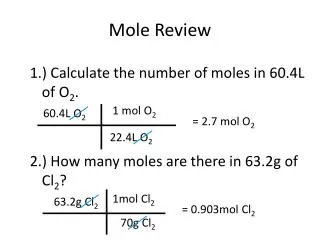
Determine the number of moles in 48 g of hydrogen gas. Express your answer to 2 significant figures. 48g H2 X moles H2 Given 48 g H2 = X moles H2 Equivalents 2.0 g H2 1 mole H2 6.02 x 10²³ 2.0g H2 = 1 mole H2 = 6.02 x 10²³ H2 molecules 1 mole x 48 g H2= X moles H2 x 1 mole 2.0 g H2 1 mole H2 Mole 6.02 x 10²³ particles Molar Mass Answer: X = 24 moles of H2
Determine the number of hydrogen molecules in 48 g of hydrogen gas. Express your answer to 3 significant figures. 48g H2 X molecules H2 48 g H2 = X molecules H2 2.0 g H2 6.02 x 10²³ molecules H2 2.0g H2 = 1 mole H2 = 6.02 x 10²³ H2 molecules 6.02 x 10²³molecules H2 x 48 g = X molecules x 6.02 x 10²³ molecules 2.0 g 6.02 x 10²³ molecules H2 Answer: X = 1.44 x 1025 molecules of H2
Determine the mass of 3.6 x 10 24 formula units of Mg(OH)2. Express your answer to 2 significant figures. X g Mg(OH)23.6 x 1024fm Given 3.6 x 1024fm = X g Equivalents 6.02 x 10²³fm 58.3 g 58.3g Mg (0H)2 = 1 mole Mg(0H)2 = 6.02 x 10²³Mg(0H)2 formula units 58.3 g x 3.6 x 1024fm = X g x 58.3 g 6.02 x 10²³fm 58.3 g calcualtor : X = 348.63 g of Mg(OH)2 Correct Answer x = 350 g of Mg(OH)2
Molar Volume: volume of one mole of any ideal gas at STP. 22.4 L
Mole Equivalents so far… 22.4 L Molar Volume = = = 2.0 g H2 = 22.4 L H2 = 1 mole H2 = 6.02 x 10²³ H2molecules Mole 6.02 x 10²³ particles Molar Mass
Determine the volume in liters of 1.0 g of H2 gas at STP. Express your answer to 3 significant figures. 1.0 g H2 X Liters H2 Given 1.0 g H2 = X L H2 Equivalents 2.0 g H2 22.4 L H2 2.0 g H2 = 22.4 L H2 = 1 mole H2 = 6.02 x 10²³ H2 molecules 22.4 L H2x 1.0 g H2= X L H2 x 22.4 L 2.0 g H2 22.4 L H2 Answer: X = 11.2 Liters of H2
Molarity: concentration of a solution Liters of Solution x Molarity = moles of solute x Liters of solutions Liter of Solution MV=mol • Liters of Solution = Volume • Volume x Molarity = moles of solute • VM = mol of solute
Advanced Level QuestionDetermine the #molecules of C6H12O6 present in 2.0 L of 0.1 M C6H12O6 solution to 2 sig figs. VM =Mole (2.0)(0.1)= 0.2molesC6H12O6 X molecules C6H12O6 Given 0.2 mole C6H12O6= X molecules C6H12O6 Equivalents 1.0 mole C6H12O6 6.02 x 10 23 Molecules C6H12O6 180g C6H12O6= 1 mole C6H12O6 = 6.02 x 10²³ C6H12O6 molecules 6.02 x 10²³molec x 0.2 moles C6H12O6= X molec C6H12O x 6.02 x 1023molec 1 mole C6H12O6 6.02 x 10²³molec C6H12O6 Answer: X = (1.204) or 1.2 x 10²³ molecules
Mole Equivalents so far… 22.4 L Molar Volume = = = VM=mol 2.0 g H2 = 22.4 L H2 = 1 mole H2 = 6.02 x 10²³ H2molecules Mole 6.02 x 10²³ particles Molar Mass
Web References for images used in this presentation (retrieved on 4/13/13. • Basketball and 22.4 L http://www.google.com/imgres?imgurl=http://pegasus.cc.ucf.edu/~jparadis/chem2045/pictures/22L.gif&imgrefurl=http://pegasus.cc.ucf.edu/~jparadis/chem2045/chapter10.html&h=147&w=219&sz=27&tbnid=ogJOpxu6GCTuOM:&tbnh=84&tbnw=125&prev=/search%3Fq%3Dpictures%2Bof%2B22.4%2Bliter%26tbm%3Disch%26tbo%3Du&zoom=1&q=pictures+of+22.4+liter&usg=__pbaUf2wjX6a1QCS3o4osovMNDwY=&docid=HnBP11ioonyqcM&sa=X&ei=3etqUYT3EpLH0gHq6oHQCg&ved=0CDIQ9QEwAA&dur=805 • Yellow balloon: http://www.google.com/search?q=yellow+balloon&client=safari&rls=en&source=lnms&tbm=isch&sa=X&ei=j-xqUZTiEseQ0QGJ44DQCw&ved=0CAoQ_AUoAQ&biw=1440&bih=1027#imgrc=RnZz087BUeKrhM%3A%3Br5ITN3_h5rYk8M%3Bhttp%253A%252F%252Fimages2.wikia.nocookie.net%252F__cb20100827193456%252Fclubpenguin%252Fimages%252F3%252F37%252FYellow_Balloon_Pin.PNG%3Bhttp%253A%252F%252Fclubpenguin.wikia.com%252Fwiki%252FList_of_Pins%3B647%3B678 • Millimole: http://www.google.com/search?q=millimole&client=safari&rls=en&source=lnms&tbm=isch&sa=X&ei=yOxqUdHIIKre0gHd7oD4Bw&ved=0CAoQ_AUoAQ&biw=1440&bih=1027#imgrc=XGyh4GH4vmgjHM%3A%3BX1Qjwmj7WBBNfM%3Bhttp%253A%252F%252Fcen.acs.org%252Fcontent%252Fcen%252Farticles%252F89%252Fi43%252FChemistsHoliday-Indestructible-Data%252F_jcr_content%252Farticlebody%252Fsubpar%252Farticlemedia_0.img.jpg%252F1337102404241.jpg%3Bhttp%253A%252F%252Fcen.acs.org%252Farticles%252F89%252Fi43%252FChemistsHoliday-Indestructible-Data.html%3B250%3B363 • Periodic table: http://www.google.com/search?q=periodic+table+image&client=safari&rls=en&tbm=isch&tbo=u&source=univ&sa=X&ei=6OxqUcPkA83h0wHw14DABQ&ved=0CDAQsAQ&biw=1440&bih=1027#imgrc=SBmm9sVgZp9MEM%3A%3BdALekFEoH5_lJM%3Bhttp%253A%252F%252Fscienceshowoff.files.wordpress.com%252F2012%252F04%252Fperiodic-table-sso-sheet11.gif%3Bhttp%253A%252F%252Fscienceshowoff.wordpress.com%252F2012%252F04%252F04%252Fthe-periodic-table-of-science-showoff-is-this-everyone-so-far%252F%3B1271%3B656 • Purple flask: http://www.google.com/search?q=purple+flask+image&client=safari&rls=en&tbm=isch&tbo=u&source=univ&sa=X&ei=JO1qUZq5EoSQ0QHnroDwBQ&ved=0CDAQsAQ&biw=1440&bih=1027#imgrc=h7SivimwYPRtTM%3A%3BwYmQQuW75HtRCM%3Bhttp%253A%252F%252Fupload.wikimedia.org%252Fwikipedia%252Fcommons%252Fthumb%252Ff%252Ff1%252FConical_flask_purple.svg%252F120px-Conical_flask_purple.svg.png%3Bhttp%253A%252F%252Fcommons.wikimedia.org%252Fwiki%252FFile%253AConical_flask_purple.svg%3B120%3B120 • Cubic yard: http://www.google.com/url?sa=i&rct=j&q=cubic+yard+image&source=images&cd=&cad=rja&docid=w0Gch7gTHE_6mM&tbnid=uqJfNRmSGhjnHM:&ved=&url=http%3A%2F%2Fwww.flickr.com%2Fphotos%2Fzanateh%2F4515124645%2F&ei=2e1qUbHLLbC-0QHKq4GQCg&bvm=bv.45175338,d.dmQ&psig=AFQjCNHEtQDxpQ11StN00HoM5PxCaYACWQ&ust=1366048602181785 • Ream of Paper: http://www.google.com/url?sa=i&rct=j&q=ream+of+paper&source=images&cd=&cad=rja&docid=Y60ii69orYVCyM&tbnid=m3ezUv6o5oAxDM:&ved=&url=http%3A%2F%2Fwww.staples.com%2FDomtar-Earthchoice-Office-Paper-11-x17-Ream%2Fproduct_755068&ei=N-5qUY2cA-LD0QHM84HwBw&bvm=bv.45175338,d.dmQ&psig=AFQjCNGhH70tDfLrs6WLGTWCUq2jf6NLCA&ust=1366048695458617 • Stone: http://www.google.com/url?sa=i&rct=j&q=scales+and+weight+and+british&source=images&cd=&cad=rja&docid=H_YPOIYCpPszNM&tbnid=Su5-v-VUlOhE7M:&ved=&url=http%3A%2F%2Fgiventodistractingothers.blogspot.com%2F2012%2F06%2Fsalter-best-of-british-review.html&ei=Lu9qUa7eEdLA4AOJ54GwDQ&bvm=bv.45175338,d.dmQ&psig=AFQjCNG3YbWuWUvR9KY1QbdRsDyPTuokFw&ust=1366048942723534 • Eggs: http://www.google.com/url?sa=i&rct=j&q=egg+carton&source=images&cd=&cad=rja&docid=mLs9LFCNzzI7KM&tbnid=qp4du8xGzQy3bM:&ved=&url=http%3A%2F%2Fwww.strombergschickens.com%2Fproduct%2Fegg-cartons-250%2Fegg-selling&ei=CPBqUfc5lcngA_W9gOAI&bvm=bv.45175338,d.eWU&psig=AFQjCNFTO2PeEtDcliTrJp_VL4mXtBroOg&ust=1366049160452595 • Chemistry EOC Reference: www.tea.state.tx.us/WorkArea/linkit.aspx?LinkIdentifier...Share