
Automata and String Recognition
E N D
Presentation Transcript
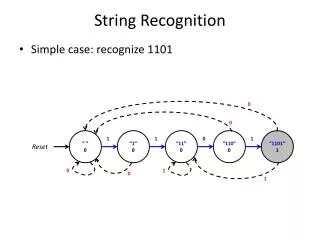
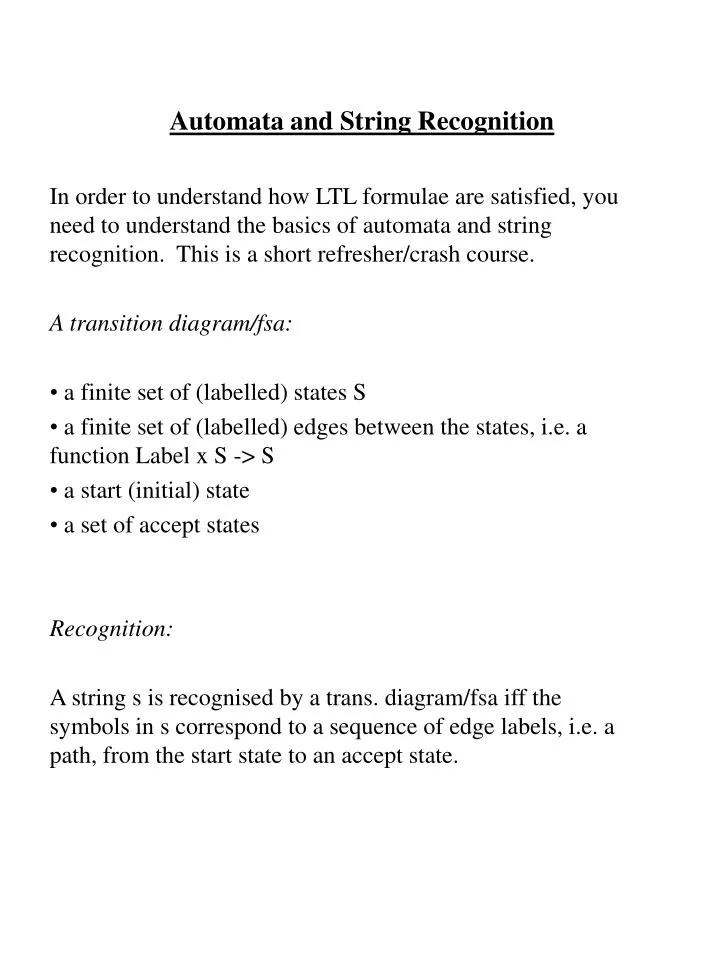
Automata and String Recognition In order to understand how LTL formulae are satisfied, you need to understand the basics of automata and string recognition. This is a short refresher/crash course. A transition diagram/fsa: • a finite set of (labelled) states S • a finite set of (labelled) edges between the states, i.e. a function Label x S -> S • a start (initial) state • a set of accept states Recognition: A string s is recognised by a trans. diagram/fsa iff the symbols in s correspond to a sequence of edge labels, i.e. a path, from the start state to an accept state.
Examples M1 M1 accepts, or recognises the strings {xy,xz}. L(M) = {xy,xz}. x y z
Examples M2 M2 accepts the strings {ac,abac,ababac, …} L(M2) = a(ba)*c M3 a M3 accepts the strings{ac,abac,ababac, …}. L(M3) = L(M2). (M3 is fully defined.) a c b a c b b,c a,b,c
Nondeterministic FSA • NFSA • allow non-determinism • transition function is a relation • A string is accepted by a NFSA if it is possible to find a corresponding path which ends in an accept state. • In practice, this means backtracking, or parallel computation. • digit • S0 digit S1 • digit digit • digit S2 S3 S4 • Are NFSA more powerful than DFSA?Do they recognise more languages? . digit
Nondeterministic FSA Theorem For every NFSA there is a DFSA accepting the same language. Example digit S0 digit S12 . S3 S4 digit
Deterministic FSA Theorem If G is a regular grammar then there exists a DFSA M st. L(M)=L(G). Theorem For every regular language there is a corresponding regular expression. Conclusion: regular expression == regular grammar == FSA If M is a DFSA, then L(M) is a regular language.
Beyond FSA {xnyn|n e N} is not a regular language. Why? Because the automata cannot “remember” n. Not a solution. G is N ::= xNy | xy (a context-free grammar) To recognise a language like this you need an automata plus a stack onto which you can pop and push symbols. If you make the stack two-ended, i.e. a tape, the you have a Turing machine! x y x y
Buchi Automata FSA accept infinitely many finite strings. Each string is finite. We are ultimately interested in reasoning about Promela programs: they range over finite states, but a particular execution sequence might actually be infinite. loop: x=x+1; goto loop We need automata that can recognise infinite strings. Such an automata is called a Buchi, or w-automata. (They also accept finite strings, in the usual way, as appropriate.) Buchi automata are just the “logical” extensions of finite state automata.
Buchi Automata An Example: Strings accepted by this automata are: {a, aba, …} u {abababab….} the usual + the infinite string finite strings a b