Download
1 / 13
140 likes | 284 Vues
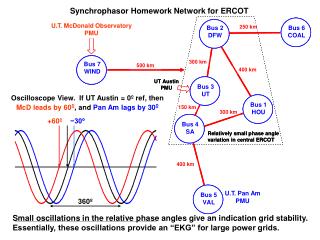
This study investigates the phase angle relationships between the UT Austin, McDonald Observatory, and Pan Am PMUs within ERCOT. The data reveals that when UT Austin is at 0º, McDonald leads by 60º while Pan Am lags by 30º. These small oscillations in phase angles serve as critical indicators of grid stability, functioning like an “EKG” for large power networks. The analysis includes 1-minute window ringdowns, highlighting the impact of unit trips on system stability, with corresponding steady-state changes and damping coefficients calculated for both McDonald and Pan Am.

E N D
Synchrophasor Homework Network for ERCOT U.T. McDonald Observatory PMU Oscilloscope View. If UT Austin = 0º ref, then McD leads by 60º, and Pan Am lags by 30º +60º −30º U.T. Pan Am PMU 360º Small oscillations in the relative phase angles give an indication grid stability. Essentially, these oscillations provide an “EKG” for large power grids.
1 Minute Window Angle Ringdown at McD 1 Minute Window Angle Ringdown at PanAm
Unit Trip, April 24, 2011, 21:15 CDT
Unit Trip, April 24, 2011, 21:15 CDT
Unit Trip, April 24, 2011, 21:15 CDT PanAm McD
McDonald Ring Magnitude, degrees Steady-State Change = 13.98 – 13.31 = 0.7 degrees Damped Resonant Frequency, Hz Normalized Damping Coefficient
Pan Am Ring Magnitude, degrees Steady-State Change = 14.40 – 17.68 = -3.3 degrees Damped Resonant Frequency, Hz Normalized Damping Coefficient
Damped Oscillation Frequencies, Magnitudes, and Normalized Damping Ratios for the Hour 21:00 – 22:00 CDT, April 24, 2011 McD Voltage Angle Relative to UT Austin UT Pan Am Voltage Angle Relative to UT Austin
West Texas Voltage Phase Angle Advances 80+ Degrees in 6 Hours