Exploring Particle Acceleration: A Hands-On Science Activity for Students
In this engaging lesson, students learn about the principles of inertia, magnetic forces, and momentum as they build and operate a particle accelerator. Guided by John Servanda and Professor Kyle Cole, students will collaborate as teams, employ the scientific method, and present their findings to the class. Key topics include Newton's Laws of Motion and practical applications of particle acceleration. This activity aims to inspire interest in science and innovation while meeting California's 8th-grade science standards. Assess student learning through lab and oral reports.

Exploring Particle Acceleration: A Hands-On Science Activity for Students
E N D
Presentation Transcript
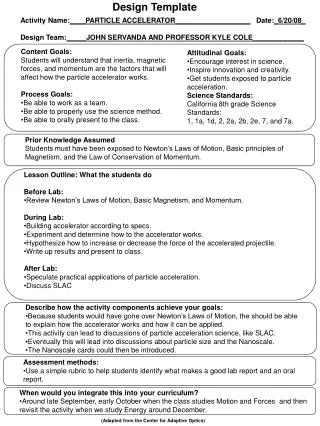
Design Template Activity Name:____PARTICLE ACCELERATOR___________________ Date:_6/20/08_ Design Team:_____JOHN SERVANDA AND PROFESSOR KYLE COLE_____________ • Content Goals: • Students will understand that inertia, magnetic • forces, and momentum are the factors that will • affect how the particle accelerator works. • Process Goals: • Be able to work as a team. • Be able to properly use the science method. • Be able to orally present to the class. • Attitudinal Goals: • Encourage interest in science. • Inspire innovation and creativity. • Get students exposed to particle acceleration. • Science Standards: • California 8th grade Science Standards: • 1, 1a, 1d, 2, 2a, 2b, 2e, 7, and 7a. Prior Knowledge Assumed Students must have been exposed to Newton’s Laws of Motion, Basic principles of Magnetism, and the Law of Conservation of Momentum. • Lesson Outline: What the students do • Before Lab: • Review Newton’s Laws of Motion, Basic Magnetism, and Momentum. • During Lab: • Building accelerator according to specs. • Experiment and determine how to the accelerator works. • Hypothesize how to increase or decrease the force of the accelerated projectile. • Write up results and present to class. • After Lab: • Speculate practical applications of particle acceleration. • Discuss SLAC • Describe how the activity components achieve your goals: • Because students would have gone over Newton’s Laws of Motion, the should be able to explain how the accelerator works and how it can be applied. • This activity can lead to discussions of particle acceleration science, like SLAC. • Eventually this will lead into discussions about particle size and the Nanoscale. • The Nanoscale cards could then be introduced. • Assessment methods: • Use a simple rubric to help students identify what makes a good lab report and an oral report. • When would you integrate this into your curriculum? • Around late September, early October when the class studies Motion and Forces and then revisit the activity when we study Energy around December. (Adapted from the Center for Adaptive Optics)