U.S. EXPORT CONTROL LAWS ANALYSIS FOR THE IT MANAGER
160 likes | 289 Vues
This analysis presented by Assistant Attorney General Wendy A. Robinson outlines the implications of U.S. export control laws for IT managers involved in international collaborations. It focuses on a hypothetical scenario where U.S. university faculty work with foreign scientists in research against tsunamis. Key aspects include compliance with regulations from the Treasury, State, and Commerce Departments; modes of collaboration; technology exchange concerns; and requirements for safeguarding sensitive information. IT managers must navigate these laws to ensure compliance while advancing scientific research.


U.S. EXPORT CONTROL LAWS ANALYSIS FOR THE IT MANAGER
E N D
Presentation Transcript
U.S. EXPORT CONTROL LAWSANALYSIS FOR THE IT MANAGER Presented by Wendy A. Robinson Assistant Attorney General Oregon Department of Justice Salem, Oregon
BASIC HYPOTHETICAL FACTS • U.S. university faculty members • Collaborate with university colleagues and government scientists • In India, Pakistan, Myanmar (Burma), Sri Lanka and Indonesia • To research and develop better early warning systems against tsunamis in the Indian Ocean US Export Control Laws
MODES OF COLLABORATION • Sharing experimental data and teaching seminars via satellite, Internet, email and DVDs • Posting experimental data to U.S. university and foreign university websites • Local exchange visits by U.S. and foreign colleagues • Development of new early warning systems and prototype equipment • Access to advanced NOAA sonobuoy and NASA satellite data • Joint papers to be reviewed by foreign colleagues before publication. US Export Control Laws
TECHNOLOGY • U.S. faculty members will provide to their foreign colleagues: - Remote ocean sensors with advanced battery packs and long-distance radio capacity to link with communications satellites in low earth orbit - Software to refine civilian-level satellite imagery into much higher resolution images - Underwater submersibles with deep diving capabilities to study underwater currents - Advanced earth movement sensors. US Export Control Laws
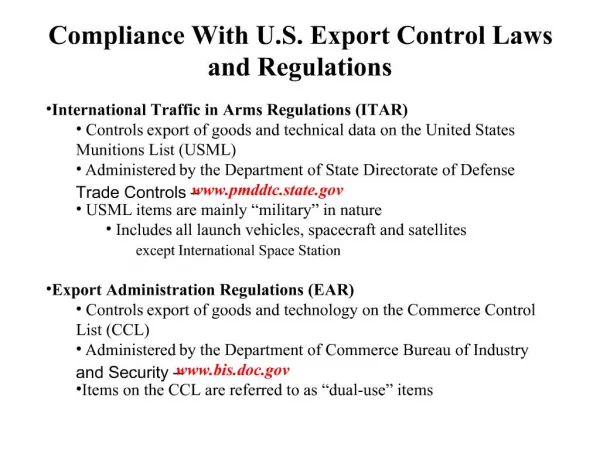
APPLICABLE U.S. EXPORT CONTROL REGIMES • Treasury Department’s Office of Foreign Assets Control (OFAC) embargo and Specially Designated National (SDN) regulations • State Department’s Directorate of Defense Trade Controls (DTC) International Traffic in Arms Regulations (ITAR) • Commerce Department’s Bureau of Industry and Security (BIS) Export Administration Regulations (EAR) US Export Control Laws
APPLICABILITY TO U.S. UNIVERSITIES • U.S. university and U.S. faculty members = “U.S. persons” • Physical exports and “deemed exports” • “Fundamental research” exemption (FRE) - ITAR: 22 CFR § 120.11(a)(8) - EAR: 15 CFR § 734.8 - OFAC: rule on “information and informational materials” [e.g., 31 CFR § 560.210(c)]. US Export Control Laws
LIMITATIONS IN RELIANCE ON FRE • Restrictions on publication • Concerns about new, non-commercial hardware or technology • Only available for activity INSIDE United States • Limits on disclosures • Limits on foreign participation (but not by foreign students in U.S.) US Export Control Laws
EXPORT CONTROL COMPLIANCE • WHERE? What are the “destination countries”? • WHAT? What is the technology involved? Is it “military” or “dual use”? • WHO? Who are the proposed export recipients? • WHY? What is the purpose of the export? • HOW? What is the method by which the physical or “deemed” export will occur? US Export Control Laws
QUESTION 3: WHO? • Faculty, staff, students at US universities • Students at foreign universities Need specific list of collaborators Need to know hidden participants • MOU or technology sharing agreement incorporating: Export control clauses Acknowledgement by foreign participants PI/university staff has to check that controlled item is still where it is supposed to be US Export Control Laws
QUESTION 5: HOW? • Physical exports of controlled hardware • Electronic exports of controlled software, “technology” • “Deemed exports” of controlled software or “technology”: - Demonstrations - Oral exchanges - Instruction or training • Posting on Internet • Academic publications US Export Control Laws
“5 QUESTIONS” APPROACH NOT A PANACEA • Does not (and cannot) make 100% legal analysis • Intended only as “first cut” approach • Does ask faculty members, researchers to think through implications of their work • Does provide foundation for faster, more cost-effective consultation with counsel • Does provide solid factual basis for any follow-up with or by U.S. regulatory agencies US Export Control Laws
NON-ENCRYPTION SOFTWARE LICENSES WITH EXPORT CONTROL CLAUSES • No problem if: • Publicly available (published) • Arises during or as a result of fundamental research • Is used in catalog course US Export Control Laws
ENCRYPTION SOFTWARE • Where? Is it being “exported” anywhere other than Canada? Embargoed countries (T-6 Plus) EU Plus countries • Who? Are the recipients of the software source or object code prohibited persons? Foreign governments or employees? • How? Deemed export under EAR only applicable to source code. Availability on the Internet is publicly available US Export Control Laws
ENCRYPTION SOFTWARE (CONT’D) • What? Is it source code or object code? If not, no problem. Is it on the Commerce Control List or listed under ITAR? BIS checklist www.bis.doc.gov/encryption/checklistinstr.htm If ITAR controlled no foreigner can have access − − − − − US Export Control Laws
EXCEPTIONS Publicly available Not source code or object code Taught or discussed in catalog class Part of a textbook US Export Control Laws