
Predicting the Diameter Growth of a Giant Sequoia Through Average Rate of Change
E N D
Presentation Transcript
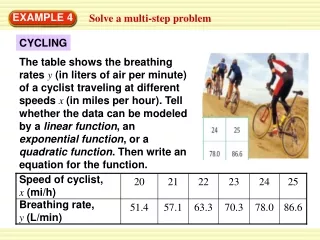
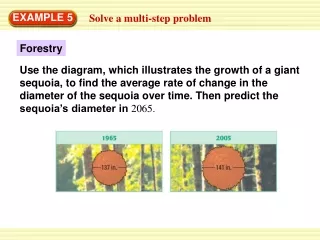
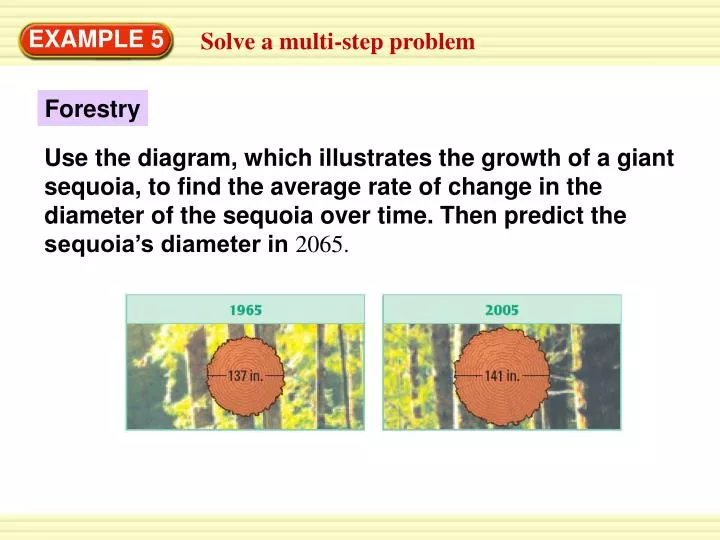
EXAMPLE 5 Solve a multi-step problem Forestry Use the diagram, which illustrates the growth of a giant sequoia, to find the average rate of change in the diameter of the sequoia over time. Then predict the sequoia’s diameter in 2065.
Change in diameter Average rate of change = Change in time 141 in. – 137 in. = 2005 – 1965 4 in. = 40 years EXAMPLE 5 Solve a multi-step problem SOLUTION STEP 1 Find the average rate of change. =0.1inch per year
ANSWER In 2065, the diameter of the sequoia will be about 141 + 6 = 147 inches. EXAMPLE 5 Solve a multi-step problem STEP 2 Predict the diameter of the sequoia in 2065. Find the number of years from 2005 to 2065. Multiply this number by the average rate of change to find the total increase in diameter during the period 2005–2065. Number of years = 2065 – 2005 =60 Increase in diameter =(60years) (0.1inch/year) = 6 inches
ANSWER The average rate of change is 0.075in. per year. In 2105, the diameter of the sequoia will be about 258.5 inches. for Example 5 GUIDED PRACTICE GUIDED PRACTICE 13.What If ? In Example5, suppose that the diameter of the sequoia is 248 inches in 1965 and 251 inches in 2005. Find the average rate of change in the diameter, and use it to predict the diameter in 2105.