Download
1 / 6
60 likes | 185 Vues
This summary presents the key findings and priorities identified during the Hydrogeology Session of the Suwannee Basin Science Workshop held on September 22, 2004. Discussion focused on critical issues such as surface/groundwater interaction, data needs, establishment of Minimum Flow Levels (MFLs), and land use policies impacting the Suwannee River basin. Other topics include the influence of political boundaries on water quantity and quality, inter-state hydrogeological challenges, and the need for comprehensive monitoring. Emphasis was placed on addressing data gaps related to geologic controls and climate change effects.

E N D
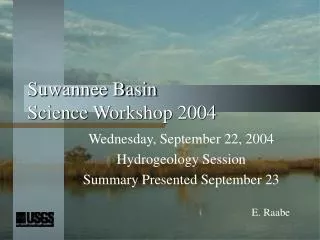
Suwannee Basin Science Workshop 2004 Wednesday, September 22, 2004 Hydrogeology Session Summary Presented September 23 E. Raabe
Most common priorities • Surface/groundwater interaction (5) • Data needs and water budget • Establish MFL’s (4) • and delineate spring-shed basins (2) • and land use policy, especially for middle and upper Suwannee (2) • Water use and availability (2) • Political boundary affects quantity/quality • Scaling issues and integration • Inter-state (FL & GA)
Hydrogeology Issues cont. • Riverine and GW impacts to estuary • Timeline of natural and human events in basin: complete history • Adequate biotic and abiotic monitoring basin-wide • Geologic control of permeability: missing • Recharge: big data gaps • Relate water availability to climate change and development plans
Threats • Nutrients • Contamination • Over withdrawal • Cross-basin transfers • Lack of coordination with GA land use
Hydrogeology issues cont. • Coordination • Of ongoing activities and sharing of equipment • More involvement with GA basin • Develop and assess management practices • Data inventory and integration • Identify data gaps (GW, geology, frequency and density, multidisciplinary, long-term) • Master Plan
Breakout groups Thursday • Distinguish between what WAS done and what NEEDS to be done • Existing funding VERSUS real needs • BRAINSTORM first without judgment • THEN let participants set 3 priorities • IF time allows, discuss timeliness, science value, management value, and…